Leaderboard


Popular Content
Showing content with the highest reputation on 04/03/2014 in all areas
-
Our neighborhood here in Riverside got a nice dose of frost this Morning. Roofs are covered with white. It's April, what the heck? I looked up Central California and even up there there was no frost. That's rather late in the year to see the white stuff.1 point
-
Come on Axel. 1) Claiming the coqui is a "great asset to the ecosystem" is way more than a stretch. 2) And "no ecological reason to remove the coqui" - perhaps not yet. You would wait for a reason??? There was no ecological reason to remove the mongoose during the first few decades after it's introduction either. When the reason became obvious, it was already too late. The coquis are a new introduction - let's see what the results are in 50-100 years from now.1 point
-
Wow Kim, that was uncharacteristically snarky. I like it.1 point
-
Chances are it will die after exposure to a typical winter of extended periods of cool and damp. By then, the name will be published and you can chisel it on the tombstone. I don't know all the "rules" but science has specific protocols for naming plants, and for a botanist to post a name on a web site prior to publication could compromise the validity of the name -- or something kind of like that. It has nothing to do with elitism. But these negative attitudes toward those who do the palm research for us, as expressed above, do nothing to encourage participation here by our botanist members. We are only putting our own ignorance on display.1 point
-
I don't think it's necessarily ethical if the most ethical answer is to maximize the number of surviving species. There's evidence pointing to the fact that our restrictions are doing more harm than good. Wait. . . What? What evidence do you have? How could preventing an invasive species do more harm than good? (harm to who or what?)1 point
-
You know you're opening up a whole can of worms here. My impression is that residents don't have any say in the matter. Are you ok with Washington determining what you can or cannot do in Hawaii? Washington? All states have their own regulations. California restrictions are different from Florida are different from Hawaii are different from Texas. Presumably this is because different locations have different eco-systems and different agricultural concerns, thus my reference to "residents". "...the most ethical answer is to maximize the number of surviving species" sounds noble on the surface. But putting that absolute into practice is probably a bit more complex. Moving species around may, or may not, disturb an existing eco-system and create an imbalance, sometimes to the point of causing extinction, and all with the best of intentions. Some imports are completely innocuous; others can spread disease that will devastate valuable crops. There has to be some discrimination, which is why regulations exist. Even with regulations, we've witnessed events such as the spread of the of the red palm weevil from Southeast Asia, across the continents into Europe, North Africa, and now in Southern California, just one example. Importing animals has always been hugely problematic. I hope you don't have any plans to bring exotic snakes to Hawaii in order to "maximize the number of surviving species." That would clearly be unethical, no matter how "cute" some people think they are.1 point
-
Axel, interesting post. At first several species pass through your mind and then when you see the fields of palms in habitat maybe your original thought changes. I first thought Vershaffeltia splendida just to see their magnificent aerial roots. Peter1 point
-
From a grower's standpoint, I can't see any merit in giving credit to the palm grown in pumice over in Hawaii. Once your palm has acclimated to your environment AND the soil it's planted in, then you will truly know how happy it is.1 point
-
I will sure love it! Here is a pic of it in the ground now, just have to wait for it to grow to show nice new palms Sabal x par ouaitetown, sur Flickr1 point
-
Happy 25th birthday, to the most well renowned palm nursery in Australia! Well done Clayton, Ed1 point
-
That would be hard. At least here where I live. Like I said only recently people have started planting diverse palm species here. All Kentia here are still small ( and they are slow in general ). Only recently Queen palms started to appear around the town. So picture should take someone who lives in other 9B areas that have long tradition of planting diverse palm species. As for me. My Kentia will soon go to the ground. It is 7-8 years in that pot. And construction of my new garden will be soon completed. So I will be able to plant many different palm species. And hopefully I will have trunking Kentia in future. OK, I went up the street to photograph the enormous ficus there, this thing is a beast, and the city just turned it into a round about. This size is a USDA 10a indicator.1 point
-
Dean, I don't know the answer. What was the difference in growth between the two?1 point
-
Lastly, here are a few photos of the dozen clumps of C. renda growing around my house There is a very large Bismarckia in front of my house. This photo was taken on the hillside above.


 1 point
 -
Yes, hence a lot of them will go extinct in Hawaii while surviving in cultivation in Southern California. I heard there have already been a few cases they've turned to Socal collectors to get seed and repopulate in Hawaii. Beaurocrats are rarely a good solution and pritchardia is no exception.1 point
-
Seems to me it would be up to the residents of various places to determine their own rules. It's not up to me to decide what can be imported to Australia, for example. Australia and New Zealand have some of the most rigorous restrictions on imports on the planet -- your shoes had better be really clean coming into the country, or they will be confiscated. It's their home, they have the right to protect it. Do all Australians and New Zealanders agree on this? No, but the majority prefer to keep their unique flora and fauna as it is. That is their business and what outsiders think is not going to be given much value.1 point
-
Acanthophoenix rubra (here in la Reunion island)1 point
-
Nonsense! biological invasions are a fundamental and integral aspect of nature and have always been present in the history of life on Earth. I can equally accuse your argument to be about as black and white as that of a 13 year old. While invasions are happening at an accelerated rate due to the accelerated means by which humans can travel the globe, so is the loss of habitat. hence the basis of the discussion, and the need to find the shades of gray in the whole argument. Invasive species are a far lesser evil than loss of habitat, and plant and animals are indeed becoming refugees. As Dean points out, there are issues, and as you point out, we need to be aware of what we're doing, but both statements are pretty presumptuous and assume we could be smart enough to really predict the impact a particular species would have. Humans have serious delusions of grandeur as to their knowledge. The truth is, we don't have the ability to predict much, especially when considering complex biological ecosystems. In many cases, there are serious benefits that no one ever foresees. For example, the introduction of the eucalyptus in California had created habitat for the endangered Monarch butterfly and provides colonization of otherwise arid, barren terrain. I would argue for the middle ground: allow invasive species, but manage them properly by monitoring and managing introductions of control species. Could I put a further restriction on that? Could we manage plants and animals introduced for agricultural purposes while eliminating damaging ones like, say, rats/cats/snakes on islands? I'm keen to introduce species like the eucalyptus if it doesn't damage the environment and can be shown to enhance or even support native life. The problem is who will decide what's cute/edible/useful? It comes back to the Coqui. . . they are cute, but screw those frogs, man. Keep a captive breeding population in a zoo or something if you're afraid they're threatened in their home territory, but they don't belong in Hawaii.1 point
-
As much as we are altering the planet, the least we can do is try to maintain the integrity of our disparate environments. The anthropogenic expansion of invasive species (plant, animal, bacteria, fungi, etc.) into new ecosystems that cannot accommodate them ranks right up with deforestation, industrialization, and agriculture in the destruction of environments and the extinction of native species. We are part of nature, but we are also self aware. The argument that the anthropogenic spread of species is "natural" is no different than a 13 year old boy arguing that he doesn't need to keep his room clean because it defies his interpretation of natural entropy. By being "lazy" in this we are wiping out species that would otherwise thrive in their niche. Therefore, as a part of nature we should protect our own environment by preventing these transgressions between ecologies. Unless, of course, you believe Homo Sapiens is the manifestation of the 6th great extinction event, and you're proud of that...1 point
-
Hmm. Wonder what the Nativist Nazis would think about the logical end of their argument. We humans are arguably the worst plague and pestilence of them all. If that's true, then, their argument, carried to its logical conclusion would be: The ethical thing for us to do for the planet would be to inoculate ourselves with the Black Death, or commit some other form of mass suicide.1 point
-
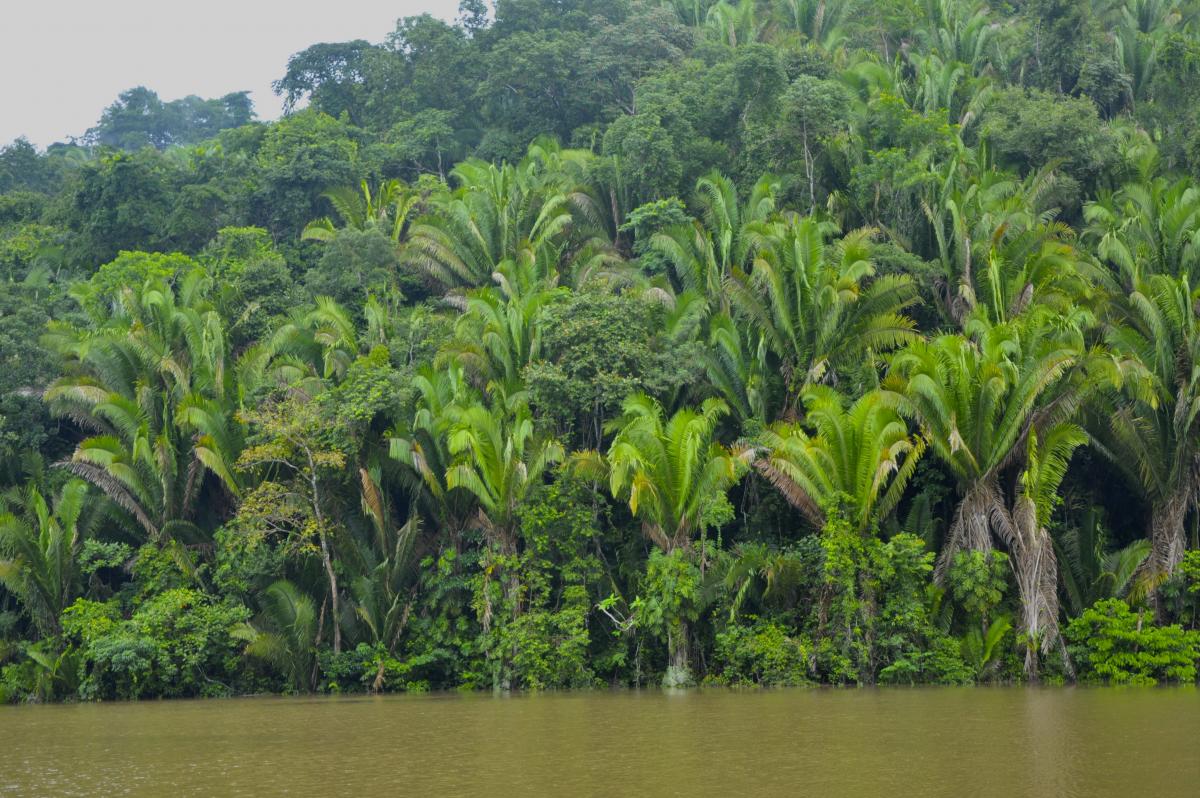
Here ya go Kim. Last year in Belize. An entire hillside covered in Attalea.
 1 point
 -
First thought, Clinostigma samoense, for their pretty trunks and perfect crowns. The colors of a Chambeyronia forest would be sweet! I have walked through canyons thick with Archontophoenix alexandrae, and they were so impressive, and standing in a large grove of Roystonea was like being in a cathedral. Floating in a canoe through a forest of Mauritia flexuosa with colorful birds squawking overhead was awesome! I remember seeing many Attalea growing in Costa Rica and Belize, but they were in a mixed forest, not a monoculture. It would be quite an experience to walk through an entire forest of Attalea. Yes! An entire hillside covered in Attalea!1 point
-
Lucky lucky you, it must look very good with the contrast of the tall Archies and more robust (and I believe) lowerChambeyronia! can you show us some pics? …… please! Many thanks Philippe DoomsDave has a mixed jungle, it's very dense, it would most definitely qualify as a forest, but it's not a forest made up of a single species. What inspired this post are the enormous alexander forests along the Hamakua coast in Hawaii. So the idea is to use a single species to do this. A little clinostigma forest:1 point
-
Clinostigma….. Rhopaloblaste !!! Or Bismarckia cloud1 point
-
1 point
-
Clinostigma1 point
-
Had a good laugh. Loved seeing all the "dummies" flying through the air......1 point
-
I don't know if I would say that is a definining characteristic, but yes, causiarum petioles are very long. It seems to me, though, that domingensis resembles palmetto a little more, except for the smooth trunk (like causiarum). Causiarum, however, is just so massive. That and the strap-like ligules really set it apart. Here is a nice domingensis at the Gizella Kopsick Palm Arboretum in St. Petersburg, FL. (Actually, two). It's hard to tell in the photo but the trunks are smooth but intermediate in size between causiarum and palmetto. The crown size is much larger than palmetto, however, and the leaves are a darker grey-green.1 point