Leaderboard
.thumb.jpg.4e91fe2cb87ace844d8164b8e9e1f271.jpg)


Popular Content
Showing content with the highest reputation on 02/13/2014 in all areas
-
Wow, they survived the 80s freezes but were killed in 2009-10 ! I think age was a big factor also. I don't know what the ultimate age of royals are, but I would think that after 100 years they won't be as quick to grow back leaves or as good at bringing nutrients up the trunk to replenish a lost crown. I know the royals you are talking about. My grandparents used to live right across the bridge in Tierra Verde, and I've been there twice, once when I was a young kid. I specifically remembered the palms and had my grandpa take me back in fall 2010. Most of the big royals along that avenue were being killed by woodpeckers, there were several active woodpecker holes all over them.maybe this is what killed them? I also saw all the naturalized royal seedling you mentioned, so I take it back, that is the farthest north I've seen royals naturalizing! Interestingly, the largest gumbo limbo I've ever seen is around there somewhere too, it's the size of a huge old live oak with similar spreading branches Well I saw the damage that the winters did to the palms and them dying right afterwards, so maybe the ones that died couldn't recover from the cold because of the woodpecker damage. There still are I think 4 big ones left though. There are at least 20 that I've counted naturalizing. I've seen them as small as strap leaf seedlings to the ones with 6-8 feet of trunk. There are probably quite a bit more than 20 though, because all the ones I have seen are next to the trails. I know the gumbo limbo you're talking about. It's at the Desoto national memorial right across the Manatee river in Bradenton. It's actually a state champion in it's spread.1 point
-
Eric - I too have three "Florida" royals in my garden. I had to have the 'elata' because the regia were every where. Was miffed when Dr. Scott Zona reclassified 'elata' as regia. I approached him and he apologized but said the DNA was the same. We discussed why the "true elata" seemed to have a less robust trunk. Royals love water but they need their nutrients to be big fatties. Over time my royals developed big fat trunks due to the loving they got. As far as the cold hardiness question, that would be difficult to determine in my opinion. My personal observations regarding the Fakahatchee Strand Royals is the are exposed to some very frigid weather by South Florida standards. I had a hunting camp about 9 miles north west of the Fakahatchee Strand for about 5 years. Many times when is was 45F in Miami, we had frost. I did not keep a log of temperature comparisons, but I may recall that my hunting camp was usually 10 degrees cooler then the temps reported at MIA. Conversely, in August and Sept. - the temps out in the Fakahatchee Strand area always seemed 10 degrees warmer then those reported at MIA. 100F with high humidity was not uncommon. We got the wild origin Florida Royals from Montgomery. We have several planted at the edge of the lake. They are growing in black wet muck. In summer they are often in standing water. These are beginning to develop very fat robust trunks, more so than others planted in the Garden. Ah, yah - mine came from Montgomery too. That's my story and I'm sticking too it.1 point
-
These were growing somewhere between the boat tour launch and Trapper John's. We took the boat tour to Trapper's and saw these along the way. There was also some big clumps of "wild Pandanus. Trapper John planted them to make the river look exotic.1 point
-
Collier state park has a great Royal Palm Hammock, plenty of parking, walk on in. Someone in a wheelchair should be able to make it in with a little push from a helper. Didn't see any venomous snakes or gators though there were a few poison-tongued gossipy people there . . . . The palms were magnificent. Get thee there if you can!1 point
-
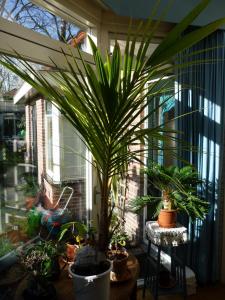
Boy, and this is the size where we in The Netherlands have to be satisfied with! This one is two years old and is grown as a hydroplant.
 1 point
 -
I have been to the Florida Royal Palm habitats in both the Fakahatchee Strand and Collier-Seminole State Park. The royals in Collier-Seminole look more like Cuban royals than the ones in Fakahatchee Strand, although that could have been my own skewed perception. It may be due to the fact that the Fakahatchee Strand royals are growing up to their knees in water where as the ones in Collier-Seminile where growing on dry land in a forest ------ at least the royals along the hiking trail in the forest were certainly not underwater. I can't speak for the rest of the park. For those wishing to visit a Florida royal palm natural habitat, Collier-Seminole State Park is much more accessible than Fakahatchee Strand State Park, although there are a lot mosquitoes there, so go in January or February. Even in December when I was there one year, it was still hot and with plenty of mosquitoes. You will see little royal seedlings popping up everywhere in the forest among teenage royals and enormous royals with thick trunks as well. The problem with accessing the Fakahatchee Strand is that the area where the royals begin to appear (at "royal palm hammock") is a 45-minute drive beyond the park entrance. It is a fairly short distance but you can only drive extremely slowly along the bumpy dirty road, unless you own an all-terrain vehicle. There were no other cars or people when I was there, but I would have had to drive into the water if another vehicle had needed to pass me. It's a narrow, one-land bumpy dirt road with water on either side. The royal palm hammock area is nice, but to get the full experience you have to hike up to your hips in water in the slough. Normally this is done in a hiking group where everyone has a long stick in front of them which they poke down in the water in front of them to gauge the terrain and to scare away any venomous snakes or alligators which might be lurking there. The experience is not for everyone.1 point
-
I'll definitely keep everyone updated! Thanks for your help:) Everyone thinks I'm crazy..."You think you can grow palm trees? in Kansas?" Well, I'm not 100% sure, but I'm definitely gonna give it a try! There's a few Trachys and Sabals sprinkled around in Wichita, so I don't see why not:P1 point
-
Great pictures Steve, thanks for sharing. That is a truly unique habitat.1 point
-
Since I am postponing any additional reasons to spend non-work time on computers until after we retire, Palmtalk is my only active forum. So right now I miss out on all your (probably very interesting) photos and updates. I also miss several other long time posters' great photos. I'm excited about the new, revised (perhaps kinder, gentler?) version of the terms of service so I can again enjoy the full range of talent here! Thanks to all those directly involved and everyone else who is passionate on the subject for your continued patience.1 point




.thumb.jpg.aa9848c04f00d26dfb36ab4dd68a22ad.jpg)