

Leaderboard
-

Kim
IPS MEMBER79Points8,416Posts -
Darold Petty
IPS MEMBER1Points4,866Posts
Popular Content
Showing content with the highest reputation on 11/14/2010 in all areas
-
1 point
-
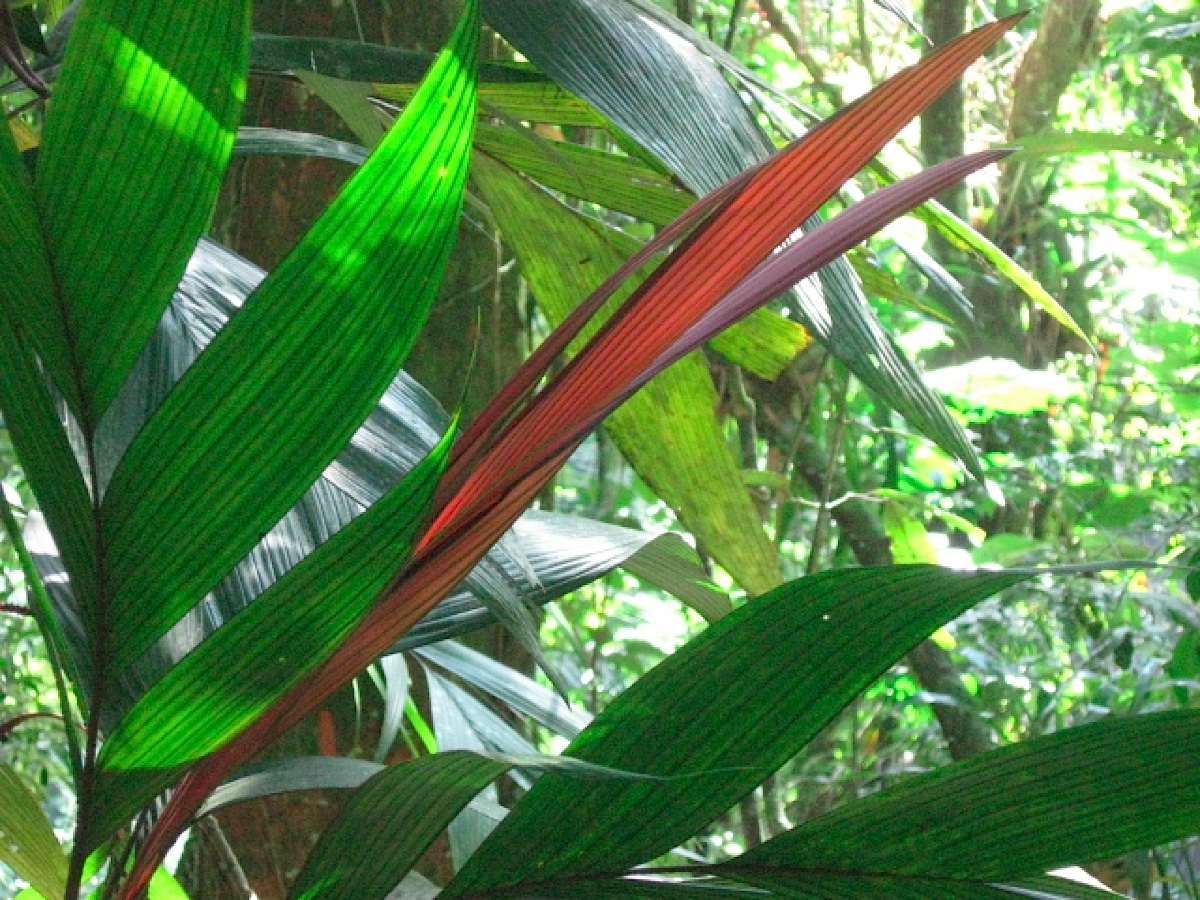
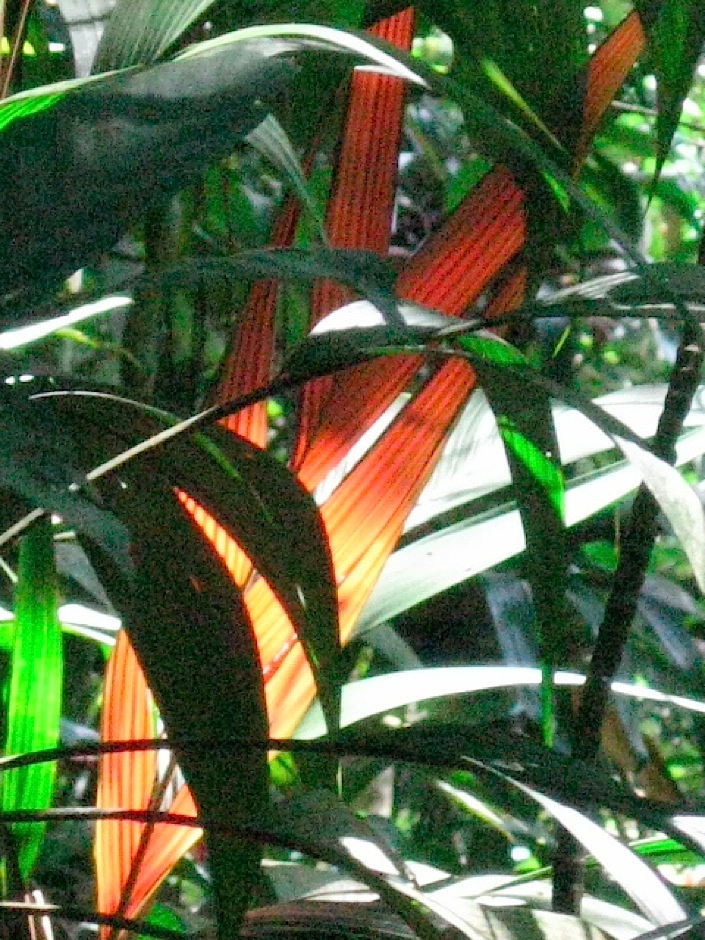
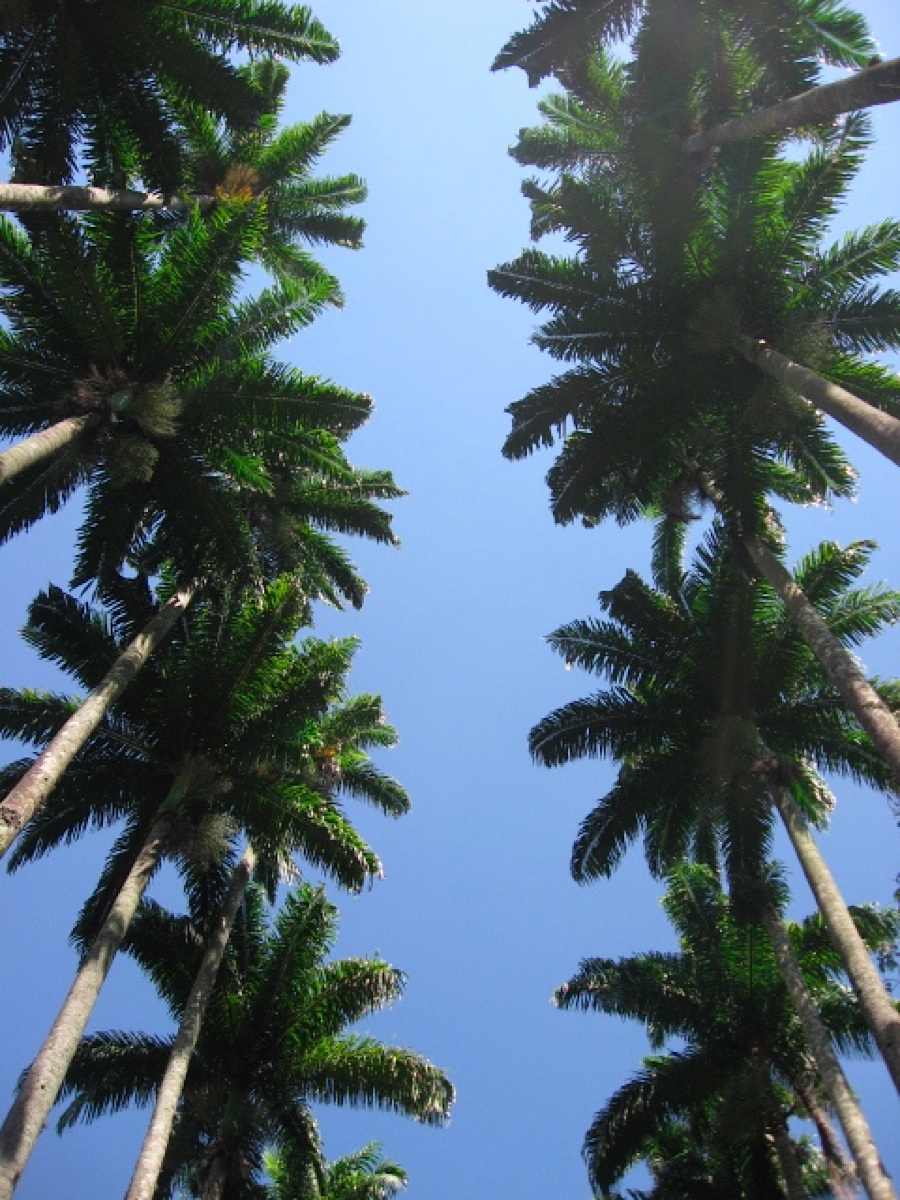
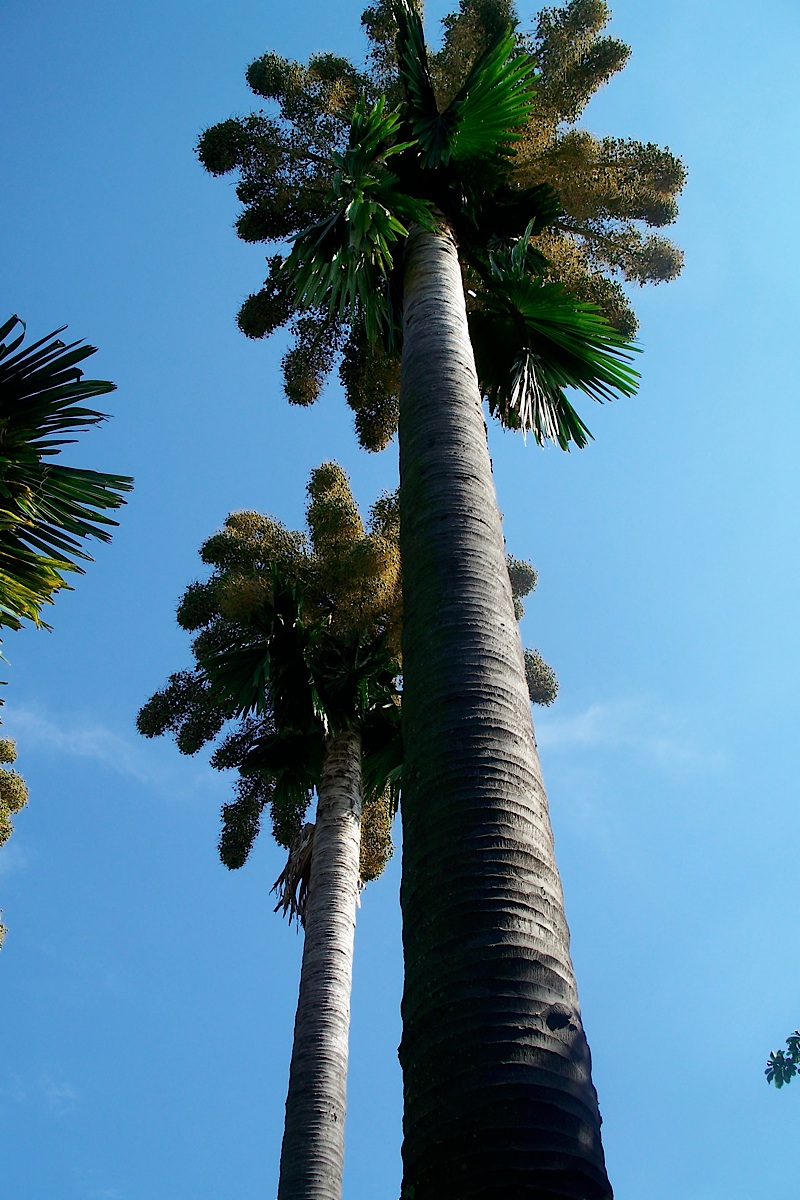
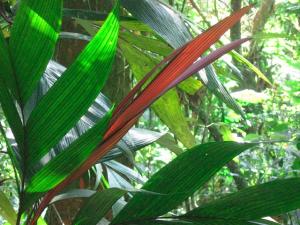
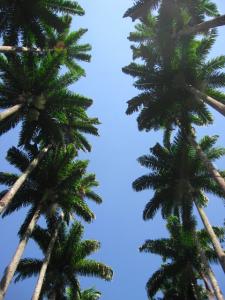
1 pointJust a few teaser photos -- we missed you, wish you had been there! Geonoma in Serra dos Órgãos National Park Palms in Rio de Janeiro Botanical Garden, founded 1808. There were lots of outstanding photographers present -- please post a few postcards from Brazil!


 1 point
 -
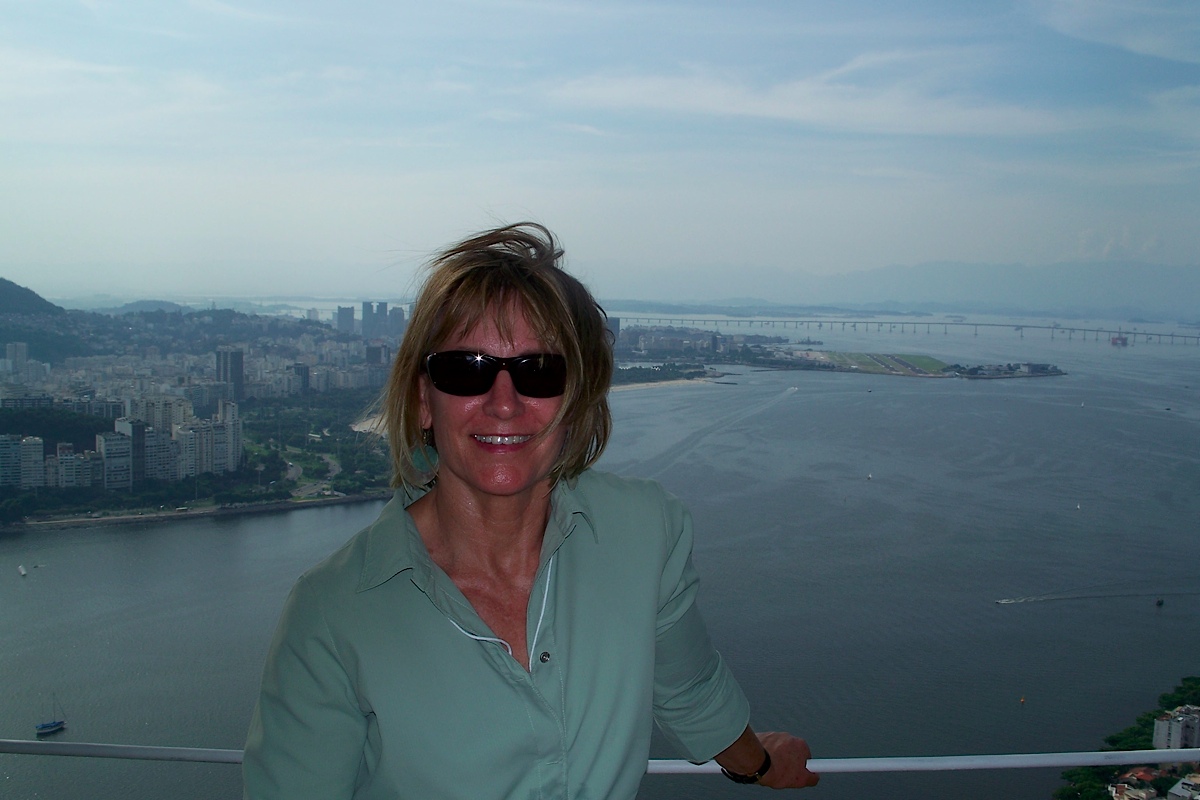
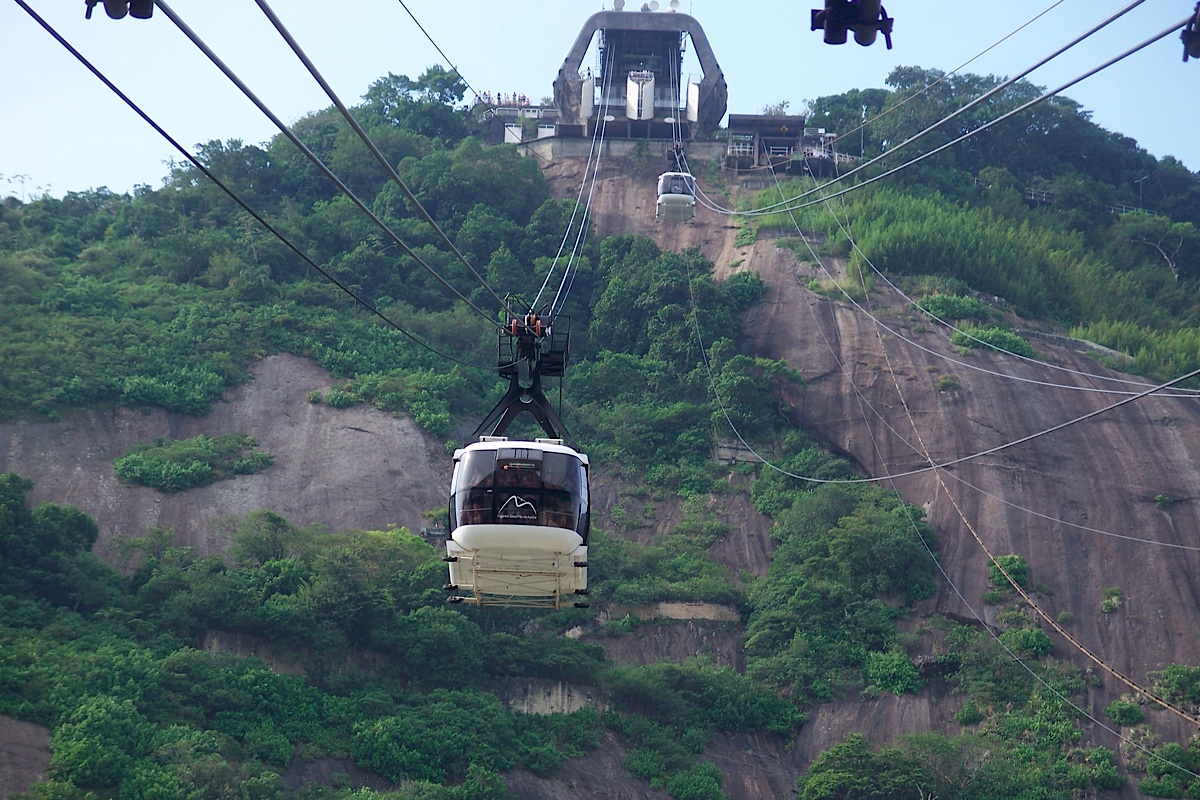
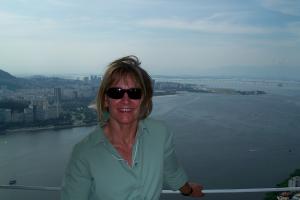
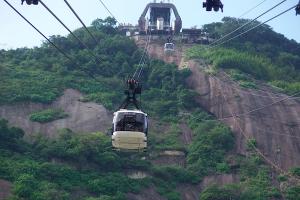
1 pointGoing up teleferico Pão de Açúcar... View from the top, lots of morros make for dramatic scenery... (say MO-hos)

 1 point
 -
1 point
-
1 pointHello everyone, One of my contributions to the IPS Biennial in Rio de Janiero, Brazil will be printing up your name tags. So I have a question for you PalmTalk attendees: in addition to your name, would you also like your PalmTalk name on your name tag? For some of us, this is not an issue; my name is Kim, and my PalmTalk name is Kim -- no confusion there. But if your name is Arnold and we know you here as The Palminator it might be helpful so your online friends can identify you. If you have a preference one way or the other, please send me a message! Thanks, and see you in Rio! Cheers, Kim1 point
-
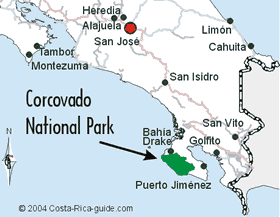
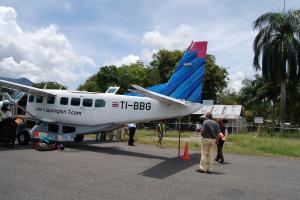
1 pointAs luck would have it, Corcovado was my destination for the Biennial Post-Trip. I had no idea who else was signed up for the trip, and received my itinerary at the very last minute, but I knew I would have to take a flight and a boat ride to get there. I didn't know the flight would be in this plane: It was a 12-seater, so I settled in directly behind the pilot. The building you see in the background is the airport where we landed, resembling nothing so much as a 1950's filling station with the added attraction of a souvenir cart.
 1 point
 -
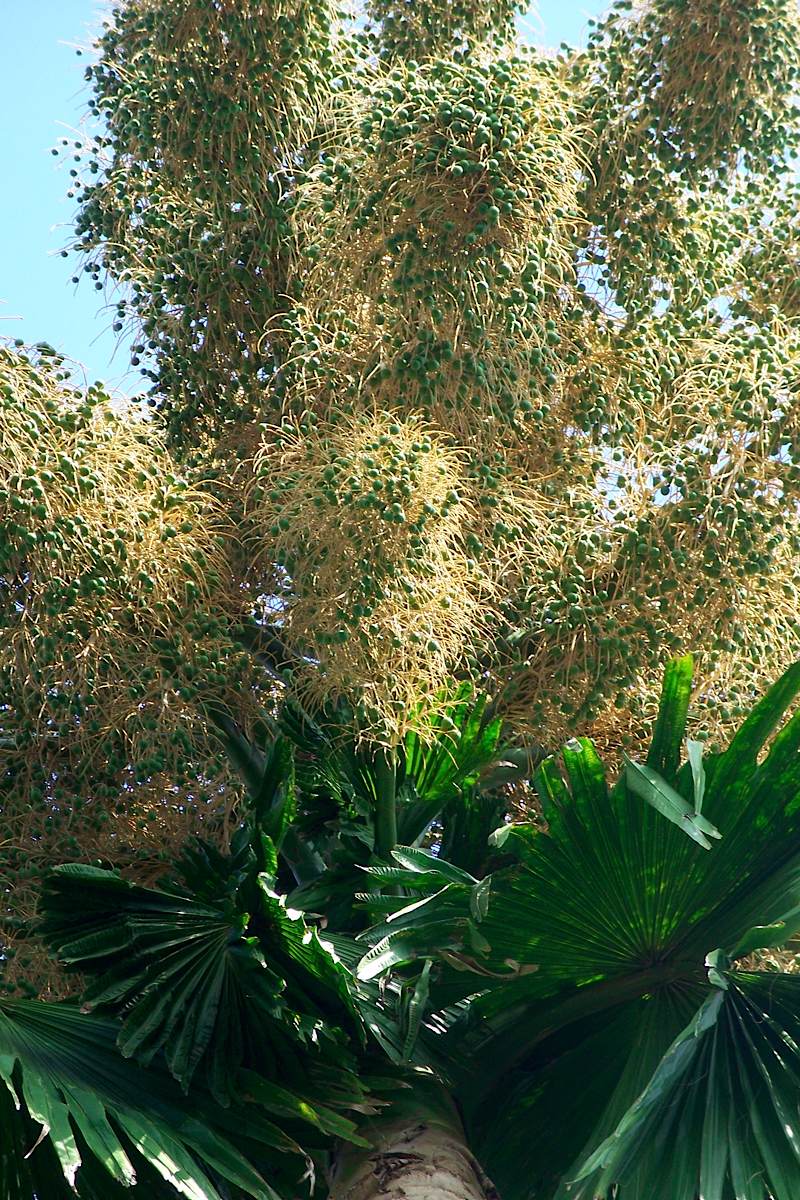
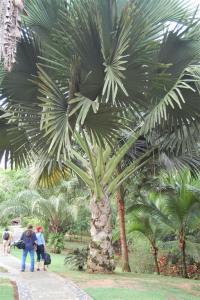
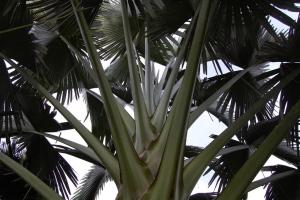
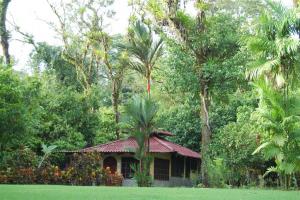
1 pointHaving arrived very late, we met in the restaurant for a mid-afternoon lunch and orientation. With everything run as energy-efficient as possible, we were advised to forgo hairdryers, because plugging one in would overwhelm the system, and the lodge would be without electricity for 24 hours. Even the pool is heated by a passive radiant heating system, warming the water to the ambient air temperature. There are no roads to the lodge, all supplies arrive by the same boats we came in on. This does not mean we are camping out in the sticks, no way. A few shots of the grounds: Closeup of the magnificent Corypha umbraculifera:
 1 point
 -
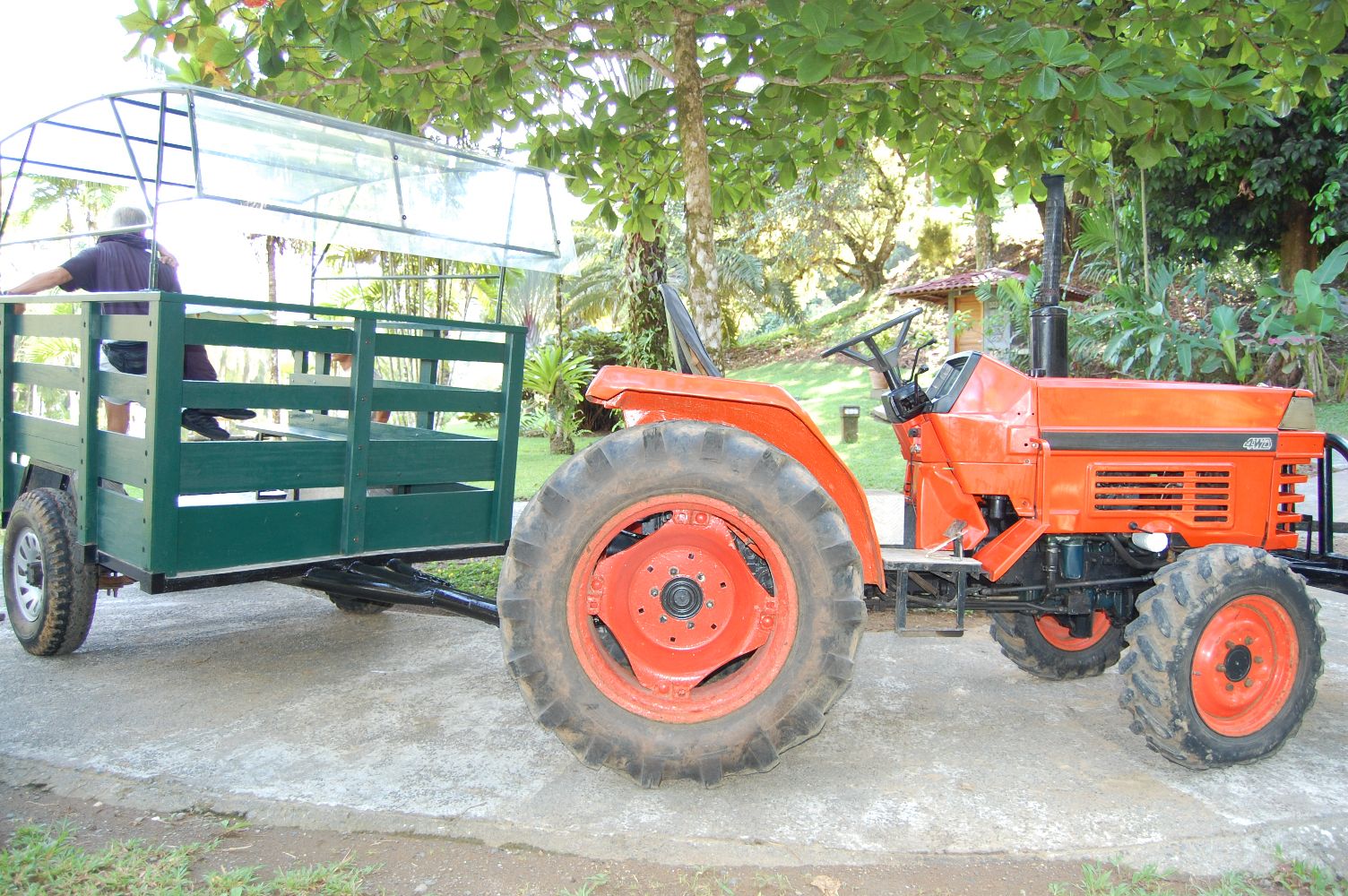
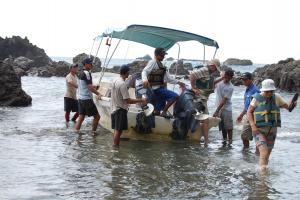
1 pointJust up from the rocks and sand we were met with a shower and fresh rolled towels for rinsing and drying our feet, and a tractor to take us up the hill to the lodge.
 1 point
 -
1 pointHey Dan, nice to see you posting here. I'm with you on the sounds of the frogs; their chimes were unforgettable, the signature for Corcovado. But just in case we do forget, we have our wind chimes to remind us. Gene, my friend, I'm looking forward to you looking forward to the photos. I kind of went "light" on the photos, this trip, though. Not my usual thousands of special moments. But you'll get an idea of Corcovado, I hope... So, where did I leave off? Oh, yes... Our boat had come through the surf at the rivermouth handily, the captain finding a channel near some vicious-looking rocks. The other pilot was racing back and forth, trapped inside without success, until finally, we saw him racing a breaking wave toward the rocks and he followed us out. A lot of drama for the people in that boat, I'd guess. From the river mouth, the fiberglass hulls of the boats smacked against the chop as we beat against the wind to the south. At one point heavy yellow rain ponchos were passed through the boat: "It's going to rain," the word came with the ponchos. Looking ahead we could see a dark grey cloud hanging over the coastline. We pulled them over our heads, and just then, sure enough, the rain came beating down. It didn't last long, and we pulled off the ponchos just before our arrival. It was a wet landing:
 1 point
 -
1 point
-
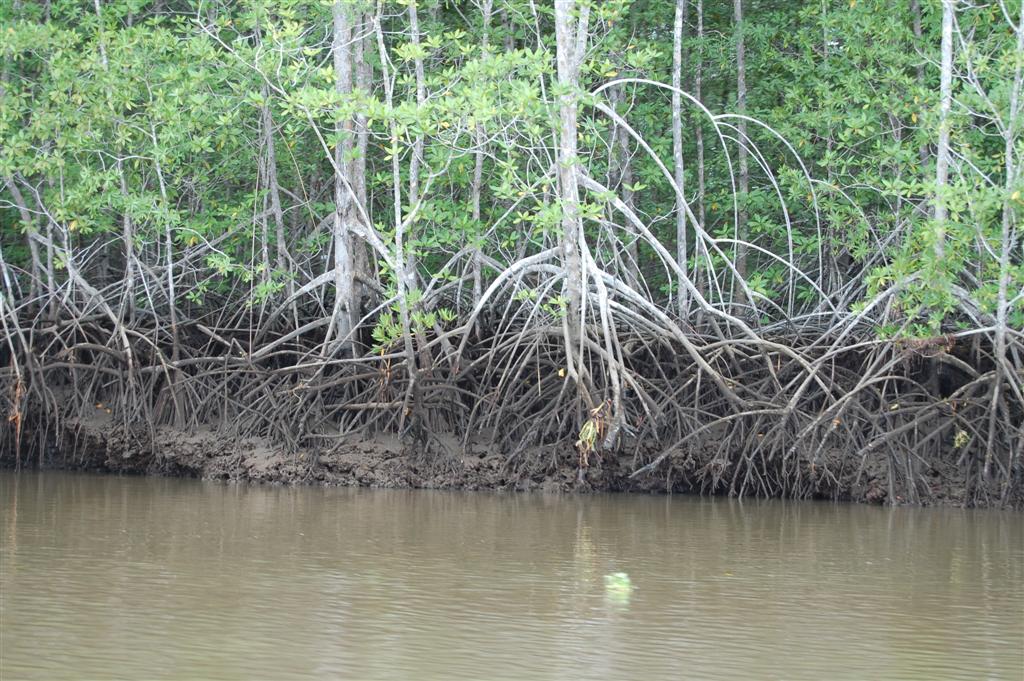
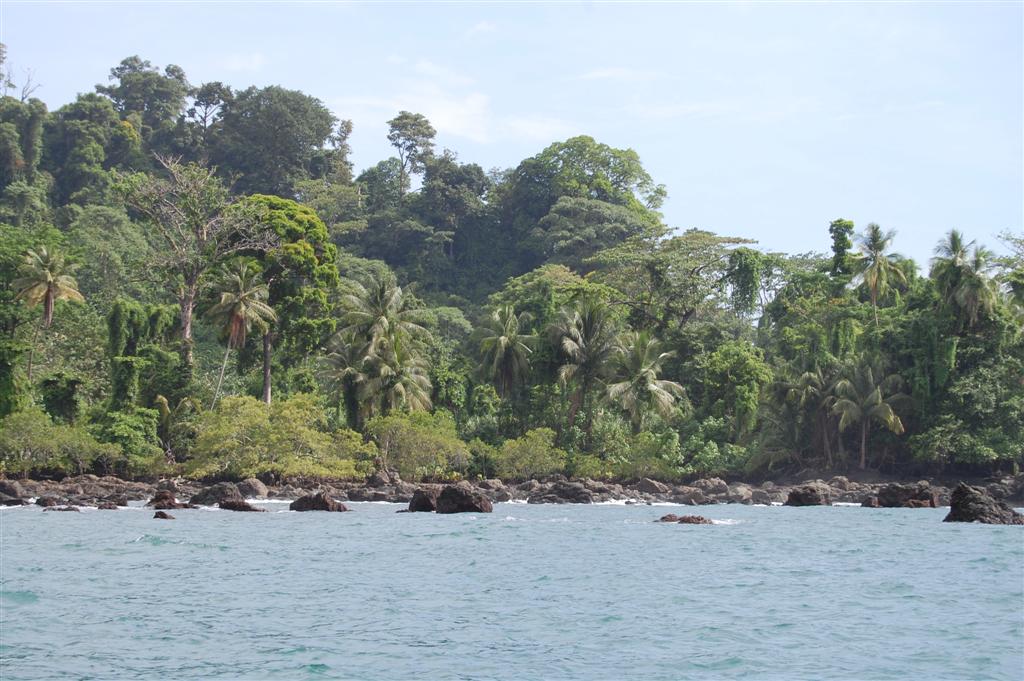
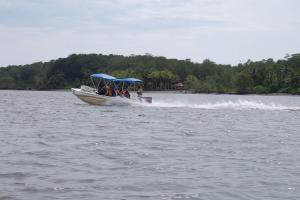
1 pointSo where are we going? Down the river delta, out into the Pacific Ocean, and down the coast. The total time on the boat was about an hour and a half, through extensive mangrove forests, past several islands, including Violin Island (photo), out through the surf, past many inviting coastal scenes.

 1 point
 -
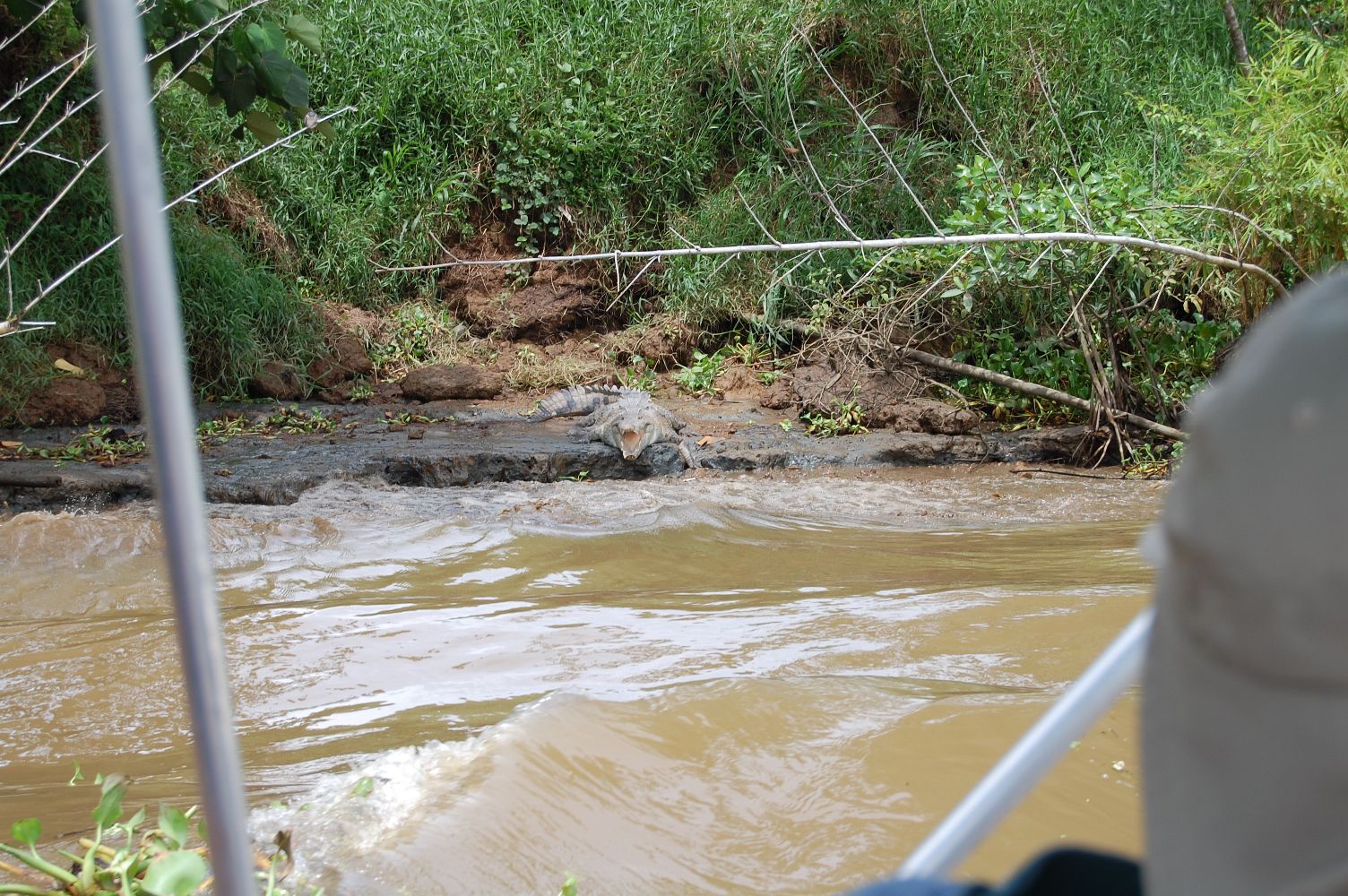
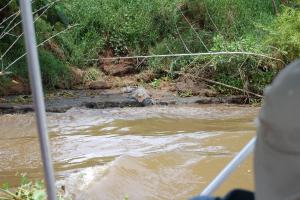
1 pointFinally loaded and underway, the boats head downriver at a very fast clip. The sound of the outboard motors and the wind in our faces didn't allow for much conversation. Suddenly the driver turned the boat 90 degrees toward the riverbank and cut the motor. At first I didn't understand why. Then I focused on the official "greeter": Just look at that big toothy smile. Costa Rica is rich in crocodiles; it is estimated there are 30 crocs for every mile of river, and the healthiest population is right here in Corcovado. So now we know...
 1 point
 -
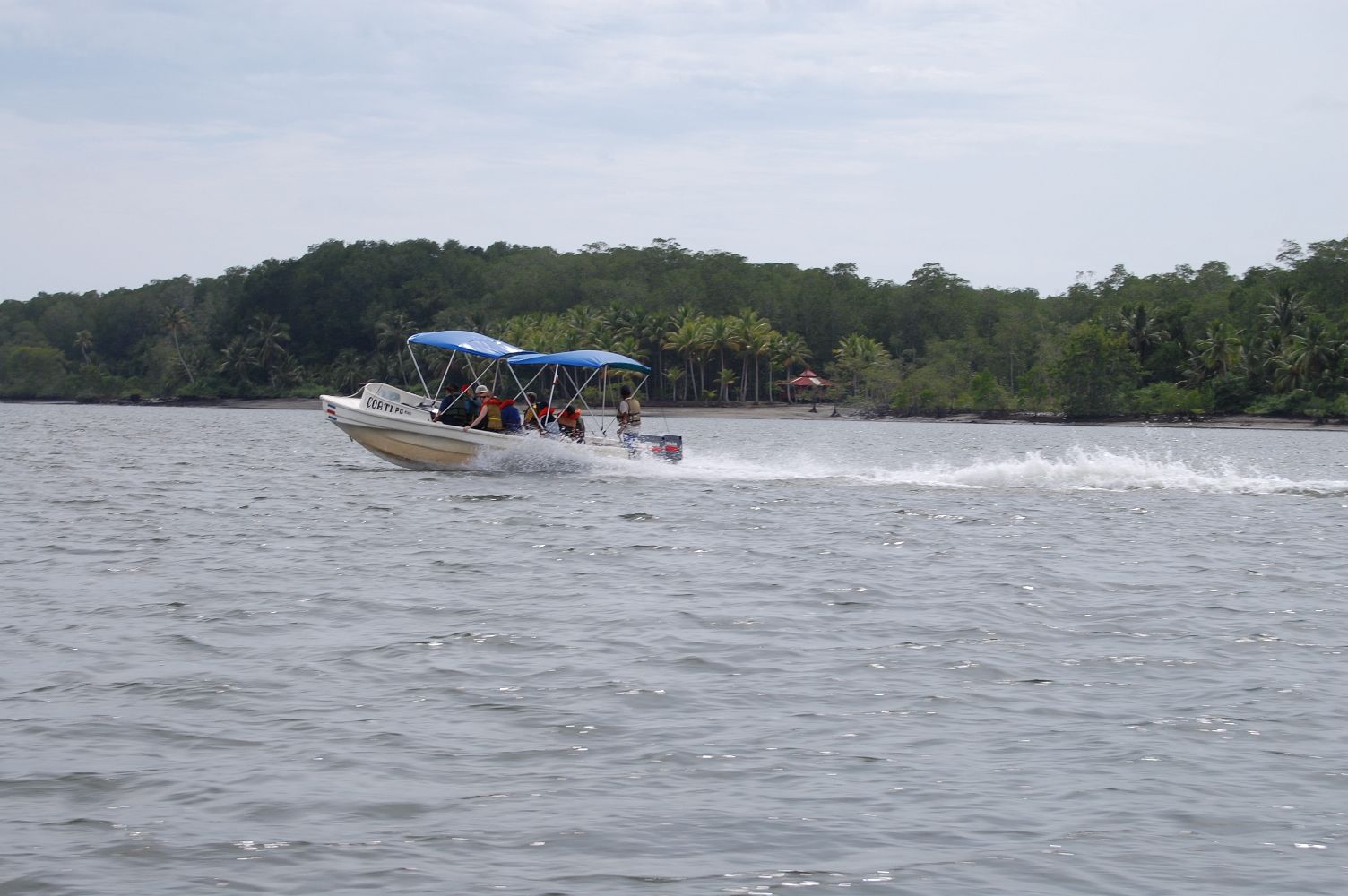
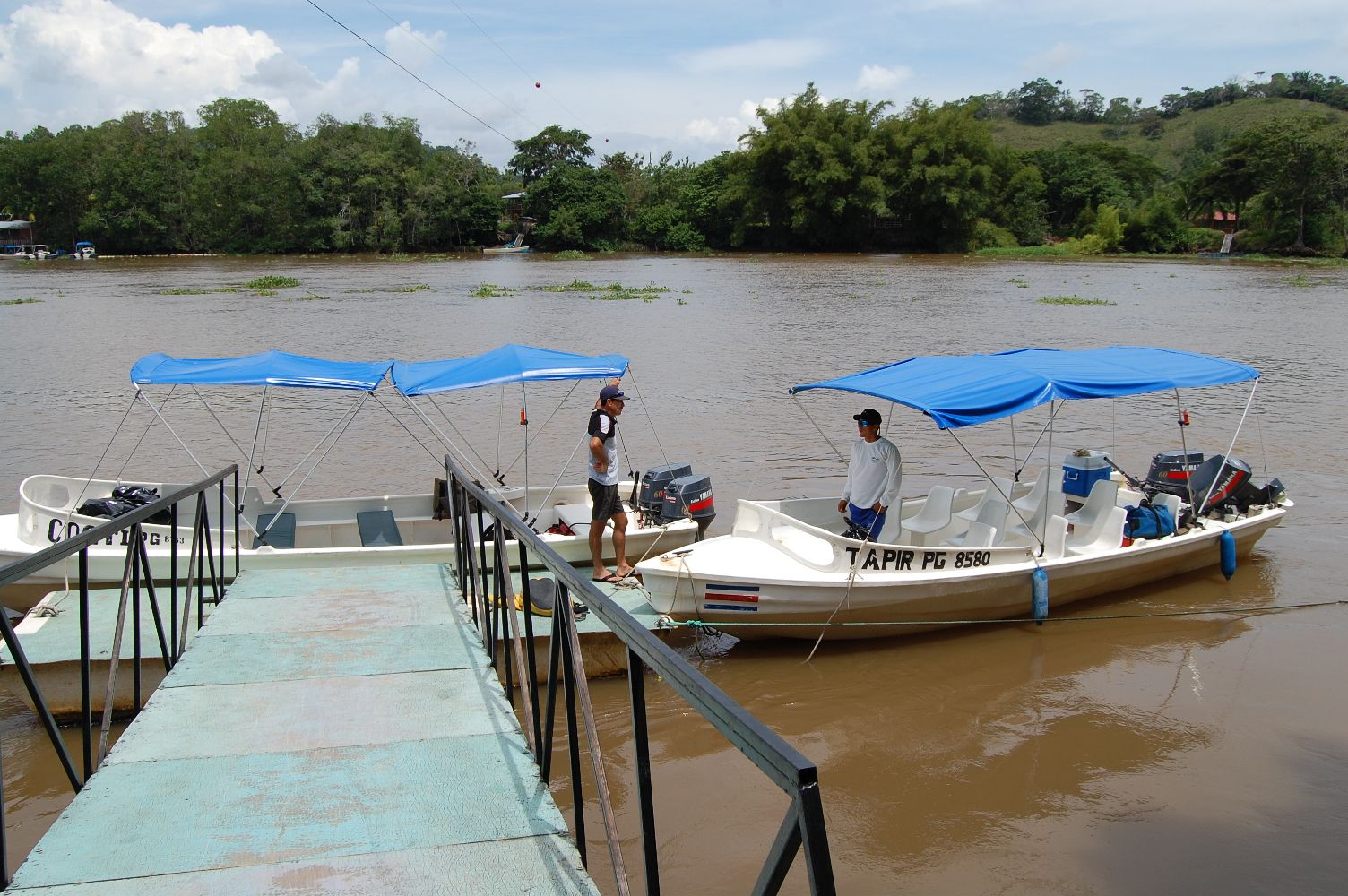
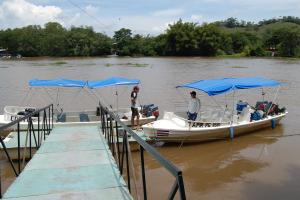
1 pointSomehow when I read we would be taking a boat, I imagined a 2 or 3 decked cruiser, similar to those used for bay cruises or whale watching in San Diego, with a snack bar and restrooms. But no, this is more like a water taxi:
 1 point
 -
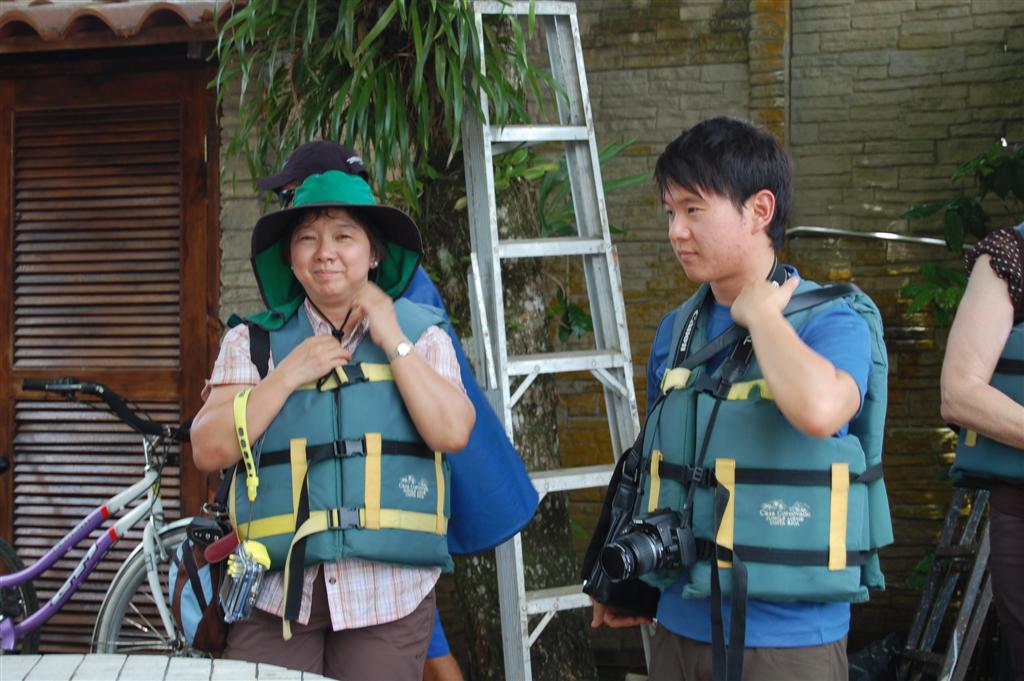
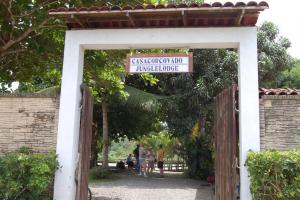
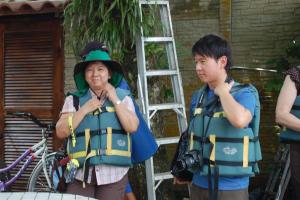
1 pointIt turned out we had quite an international group on the Corcovado post-trip, including the Yao family from the Philippines, George, Aurora, and Garvin; Urs and Susanne Germann from Switzerland; Dan Ashley from Hawaii, USA, Stephen and Bunni Collins from Barbados; Grant Stephenson from Texas, USA; Jayanne Crawley from Louisiana, USA; and Kim (self) from California, USA. We also had the company of Dawn from the UK, who was doing research for the travel agency where she is employed -- nice work if you can get it! We are met by our guide, and transported to the Hacienda, where it is suggested we change into shorts and sandals and have a beverage while they pack our luggage into plastic bags. We surmise we may get wet. This is reinforced when we must don life jackets.
 1 point
 -
1 pointFlying in, I had seen cultivated fields below, the crops appearing star-shaped from the height of the plane. Pineapple? Couldn't be, too large. As the plane descended and approached the fields of "stars", it became obvious these were extensive fields of palms, very large palms! They are African oil palms, a crop that replaced bananas here many years ago.
 1 point
 -
1 pointAs you can see, the Malagasy are industrious people; they work hard. All along the road, there is something for sale; a rabbit held by the ears, a chicken, a string of fish. I felt bad for the little bright red birds that were captured and held out for sale in small round baskets. I think European tourists buy them and set them free. Bird seller Birds for sale Melons and umbrellas Oranges As we enter Antananarivo, the sun is setting, and the traffic is becoming ensnarled. It takes a long time to get across the city, and everyone is tired. Eventually we get to Bruno's house for a quick shower and repacking of our (at last!) recovered luggage. Then it's a last delicious dinner, and a ride to the airport. Our plane leaves at 1:30 am, so it's very late and the streets are nearly deserted except for the dogs. The capital city is still an undiscovered place for us, just streets and buildings looming in the darkness. While we have seen a great deal, we realize we have missed so much more! I would go back in a heartbeat! ------------------------->>>>The End<<<<---------------------1 point
-
1 pointImpressions, continued... Calf and umbrella Bundle of brush Drying corn Melons and birds for sale1 point
-
1 pointWith many kilometers yet to go, we quickly leave the palm behind. A brief stop for lunch in Ambalavao, where Bruno charms the ambivalent restauranteurs to serve us quickly, and we're back on the road again. As the sights along the road fly by in the rain, I realize these are people and scenes I don't want to forget, so I try to capture some impressions through the wet windscreen. These are not intended to be great photos, just impressions. Maybe they'll find their way into a painting someday... Carrot harvest Girl with blue umbrella Roasting corn Walking to market1 point
-
1 pointA few more shots of this splendid, solitary specimen: I wish the photos might have been better, but it was a struggle just to get these on the steep hillside amid the brush and trees in the rain!1 point
-
1 pointAlong the road we hope to see a particular palm we missed on our drive out to Isalo. Bruno watches the milestones carefully, and pulls off the road in the middle of a curve. Parking up the hill, it begins to rain lightly as we cross some grazing land, skirt a modest corn field, and traverse a brushy area over the hilltop, until finally we spot this palm: I have to squeeze through thick, high brush to get close to it, and it's difficult to get a good shot because of the dense shrubbery around it. I am told this may be the True Dypsis ambositrae (if I remember correctly!!!). I would like to know what the experts think. Very sadly, right next to this specimen another is cut off at the knees, the trunk lying horizontally. Why anyone would come all the way out here to whack a palm down and then leave it lying there is beyond me... But there is a juvenile sprouted at the base: Vertical view of adult:1 point
-
1 pointBack of the main building, said to be a former church: Breakfast inside: On the road again later, Steve was fascinated by the brick-making. The bricks are made from clay dug on site, molded in ladder-shaped forms, then probably dried for a time in the sun, and stacked up for firing. The stacks are made with oven-like spaces for the fire inside the bottom of the stack. In Tanzania we saw the entire pile covered with mud before firing, but they don't seem to do that in Madagascar. The fires burn for weeks. It's a long process, and it takes a lot of bricks to make a house.1 point
-
1 pointA few scenes of Fianarantsoa, the guest house and gardens: View from our balcony For the car buffs, this was in the driveway:1 point
-
1 pointAlas, our time is up, we must retrace our steps. A few final glances. Looking upward at a wall of lush ferns. Still no lemurs in the trees, so it's back through the tall grass and the fields. And so ends our sojourn at Parc d'Isalo. We return to Chez Berny in Ranohira for some more delicious mango salad and then reluctantly hit the road for the 2-day drive to Antananarivo. We will see a few more palms along the way, but we know the trip is winding to a close. Check back again for the last bits.1 point
-
1 pointI hope this isn't too repetitive; every few steps gives a different perspective.1 point
-
1 pointThey start very tiny, like this 4-inch seedling in a crevice: With luck, many years later they are still reaching for the light at the top of the canyon. Elegance personified: Steve for scale:1 point
-
1 pointKnowing my time was very limited I was concerned that I might have come halfway around the world and missed the palms I craved. We insist on hiking deeper into the canyon, though the guide says it is all pretty much the same. We scramble over boulders beside the rushing water, our steps sink into soft sand bars, and we hop rocky-by-rock over swirling pools. A great sigh of relief; our persistence is rewarded: We arrive at the grove so familiar from Gary LeVine's photos. This is bliss. The palms grow right out of the rock and from impossibly vertical surfaces.1 point
-
1 pointDo you see the creature in this picture? He's doing his best to blend in... At first I was a bit puzzled; there were a few R. glauca around, but not nearly the concentration I had expected. I even wondered if we were in the right canyon. Lala assured me that this is the canyon visitors find most beautiful; and it really is a jewel. We walked a bit farther into the canyon and found this small palm clinging to the rock wall:1 point
-
1 pointI thought we were going into Canyon of the Rats, but no, it's the Lemur Canyon. I believe we did the shorter trail: Passing through a forested area, we check for lemurs, but find none. However, a bit further along the trail we come upon our first, absolutely stunning Ravenea glauca. Continuing on, we cross the creek again, and here, the canyon walls are narrower, and it's pleasantly cool in the shade. We arrive at a seeping spring and crystal pool, and Lala explains this pool is considered sacred and could only be used by the king. But then one day the king came to the pool to find lemurs drinking from the spring, so from then on, the king decreed only the lemurs could use the water, except for rare ceremonial occasions. Today of course, many a tourist kicks off his shoes to wade into the pool.1 point
-
1 pointAnother Day, Another Hike So many trails and canyons, so little time! We must leave Parc d'Isalo around mid-day to allow enough time for the return to Antananarivo, but the morning will permit some exploring. We secure our tickets and our guide, and Bruno patiently guides the truck over a very rutted and abused clay road for 30 minutes to take us to the trailhead. Along the way, the fields are scattered with Bismarckia nobilis. The trunks, burned and scarred, show evidence of a hard life: In the distance we can see the mouths of two canyons: At the trailhead we remove our shoes to cross a small river, then pick our way through muddy fields and past rice paddies to reach the mouth of the canyon.1 point
-
1 pointTurns out he likes butter cookies, and he grabs my fingers to take the cookie bits. The black pads on his fingers are soft and cool: He also responds to the sound of crinkling paper, like candy being unwrapped -- ooo, what have people been feeding this guy? Watching him bound forward like a giant frog is a little intimidating. He really gets friendly with Steve, jumping on his bended knee, then up on his shoulder: Bruno et le maki: As you can see, the sun is setting, the end of a perfect day. More pictures later.1 point
-
1 pointThere isn't enough daylight for another hike today, but the proprietor of the restaurant, Berny, a French-descended Malagasy, has a lemur on a camping property not far away, and we haven't seen any lemurs yet, so off we go. We arrive at the deserted camping area and park near the lemur house where he sleeps safely at night. Bruno walks us down to the pandanus-surrounded oasis where the lemur hangs out. We call "Maki, maki, maki!" The lemur is habituated to (French-speaking) humans, and we hope he will respond. Lilia wanders off to find plants. Steve goes down to the edge of the water. Bruno goes back to the vehicle to look for something to feed the lemur. "Maki, maki, maki!" Suddenly I feel a furry presence between my ankles; I look down and there is a furry ringed tail! It's the lemur standing calmly between my feet. I instinctively reach down to pet his tail, as though he were a cat, and he looks up at me as if to ask, "Got any snacks?" This magic moment doesn't last long; after a moment of wonder he scampers into a tree: But he comes down again to poke around the garbage:1 point
-
1 pointAfter the hike we return to the town of Ranohira for lunch at Chez Berny. The interior is typical for the region: Those are various flavors of rum in the jugs. I did not sample them. When the appetizer arrives, we conclude this is a five-star restaurant. Check out the mango dish: After lunch, the kids get out of school nearby. They are all wearing their purple uniforms and I can't resist a couple of pics:1 point
-
1 pointThere are many palms in the cool and shady canyon: And at last we reach the pool: Unfortunately it is filled with sand as a result of the cyclone from a week ago, but the water is still flowing and it makes a pleasant destination. Steve above, Bruno below: Blue dragonfly:1 point
-
1 pointAt last! Dypsis onilahensis! And many more in the canyon below -- see their crowns poking up along the canyon rim in the background: Closer look at trunk: Descending into the narrow canyon, a palm with seeds:1 point
-
1 pointThe canyon edge: It's green down below where the spring runs: Perhaps I should explain the "ancestors' tombs" a bit. In Madagascar it is the custom to bury the ancestors in the cliffs, first in a coffin: Then 4 years later, they return and unearth the coffin and carry it to town where a celebration ensues with much eating and drinking (of rum) and the family shares memories of the family member who passed. The bones are removed from the coffin and carefully re-wrapped in silk shrouds, then carried back to the cliffs, and lowered down to be entombed in a final, smaller resting place. Another tomb in an interesting rock formation:1 point
-
1 pointThis is a very dry area, but certain things flourish here: It takes a long time for a pachypodium to develop this interesting shape:1 point
-
1 pointRock with vividly colored lichens growing on it: This is the area where Lala's ancestor's are entombed. To reach the tombs, people are lowered with ropes. It's a wonderful viewpoint. Wet valley below:1 point
-
1 point
-
1 pointAdd a stone to the pile and make a wish. If I remember right, it's kind of like the Trevi Fountain in Rome; if your wish comes true you will return to Isalo. Or something like that! Unique plant in dry areas: Bruno, Lilia, Lala, and Steve on the hot trail: View from the trail to the plain below:1 point
-
1 pointWe load up the vehicle: Today we are hiking to La Piscine Naturelle (the Natural Pool) and expect to see...PALMS! Lala is our guide for the day. His presence is required and his English is very good. Some of his ancestors are entombed in the cliffs in the park.1 point
-
1 pointI'm fairly certain these are Dypsis mananjarensis, across a wide ravine from the road, looking magnificent atop a hill: Another shot, notice the inflorescence: Much further along the road we find this solitary palm, roots holding it bolt upright on the extreme edge of the road cut: Let's put a human in there to give you some idea of its size (and can you tell me which species?): I'll let you drool over that for awhile; I've got band practice now. I'll try to post a few more tonight. We're just now getting into palm country here...1 point
-
1 pointSuch a tall beauty: The Residence is now populated by chickens: Red clay stairway: We were curious about this very large tree in full, glorious bloom with red flowers; any idea what it might be? (This photo is taken from a great distance, sorry about the lack of detail.)1 point
-
1 pointOkay, okay!! I'll quickly post a few before I attend to my other obligations this evening... Milestone: I honestly can't recall if this is Dypsis mananjarensis or ifanadianae; I'll guess the former. It's just down the road from Ranomafana, but we have a greater distance to travel. Pineapples for sale: "Residence" from way back when the French were still here, a line of towering Clinostigma marching up the drive. The caretaker had planted a few offspring to fill in the blank spots, assuring continuity of their presence here.1 point
-
1 pointI can't get enough of these terraced hillsides; I'd have thought I was in southeast Asia. Pouring rain at Lilia's place: Foodie pic for Paul: I should mention we ate very well while in Madagascar, due primarily to Bruno having already scouted the good eats on past excursions, but also due to this once having been a French colony. That's camembert cheese and marinated mushrooms on the skewer, and yes, that's a Ravenea rivularis trunk behind me. Stay tuned. Next up: colonial Clinostigma, Dypsis mananjarensis and Dypsis ifanadianae.1 point
-
1 pointDriving back toward CentRest, a few shots of the road damage I mentioned earlier:1 point
-
1 pointAs you would expect, it rains a lot in the rainforest, and we witnessed this phenomenon first hand. Because the weather was otherwise warm, it didn't bother us at all; in fact, it had a pleasant cooling effect when we might have been too warm hiking uphill. My only concern was to keep the camera dry. Epiphytic ferns: Fern Still trying to get a good shot of that palm...1 point
-
1 point"Ground orchid": Cyathea: This little green frog, endemic to Madagascar, inhabits this type of pandanus exclusively.1 point
-
1 pointGiraffe beetle: There were many understory palms and bamboos. We thought this was Dypsis nodifera based on the leaves, but don't take my word for it. Our guide was very good at finding frogs; we'd never have seen them without her help.1 point
-
1 pointThis is one animal we won't see -- the fossa -- it's nocturnal and extremely shy. So off we go... Right away we see several of these palms, and we're tossing out guesses as to its identity: We thought these were the same, but it's hard to get a decent shot. It was even hard to get a clear view in the dense forest.1 point
-
1 pointIn the morning we arrange to take a walk in the rainforest. Will we see any critters? Maybe... We stop at the big waterfall first. Our guide looks like one of my daughter's surfer friends from Ocean Beach or Santa Barbara: This is the Andriamamovoka waterfall on the Namarona river, which drops into a very narrow canyon far below. I recorded the sound, but can't figure out how to post it; suffice to say it is really LOUD.1 point