Jump to content
  • WELCOME GUEST

    It looks as if you are viewing PalmTalk as an unregistered Guest.

    Please consider registering so as to take better advantage of our vast knowledge base and friendly community.  By registering you will gain access to many features - among them are our powerful Search feature, the ability to Private Message other Users, and be able to post and/or answer questions from all over the world. It is completely free, no “catches,” and you will have complete control over how you wish to use this site.

    PalmTalk is sponsored by the International Palm Society. - an organization dedicated to learning everything about and enjoying palm trees (and their companion plants) while conserving endangered palm species and habitat worldwide. Please take the time to know us all better and register.

    guest Renda04.jpg

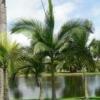
Phoenix canariensis in habitat


Recommended Posts

Posted

I was going to add these to the thread that Carlo started, but I couldn't find it.

These pictures are from a wild grove in the same valley as a plot of land that Carlo owns.  Pictures from Carlo's garden to follow on another thread when I have time.

Picture one:

Phoenix_canariensis_Grove.jpg

This was a very impressive site in person.  Even on a cloudy day it looked quite spectacular.

Picture two:

Phoenix_canariensis_Grove_2.jpg

This is taken from the same vantage point, but panned left a llittle.

Picture three:

Phoenix_canariensis_Grove_3.jpg

Considering the lack of rainfall, other than the day I was there, they look very healthy, but there is planty of water below ground that flows down from the cloud forests.

Picture four:

Phoenix_canariensis_Ravine.jpg

Carlo can probably clarify this, but this palm is growing in a ravine, so basically it is a rheophyte.  I'm sure Carlo said this palm was only five years old, again he can confirm, if he wishes.  I find that somewhat astounding, maybe I took a photo of the wrong palm.

]

Corey Lucas-Divers

Dorset, UK

Ave Jul High 72F/22C (91F/33C Max)

Ave Jul Low 52F/11C (45F/7C Min)

Ave Jan High 46F/8C (59F/15C Max)

Ave Jan Low 34F/1C (21F/-6C Min)

Ave Rain 736mm pa

Posted

All of the palms pictured above are pure canariensis, but there are many hybrids in the region.

This is a red fruit hybrid:

Phoenix_Red_Fruit_Hybrid.jpg

Carlo described this as a thin leaved hybrid:

Phoenix_Thin_Leaved_Hybrid.jpg

Phoenix canariensis are used extensively all over the island, particularly in the south, as decorative palms, lining roadsides and the like.  Unfortunately many of them are at the height where the fronds pose a threat to pedestrians and so are quite heavily pruned.  Most of the palms lining the roads only had 2-6'/0.6-1.8m of trunk, which I hope isn't because they get replanted regularly, because they aren't cared for.  There were certainly extensive irrigation systems running everywhere, so hopefully all of the palms will grow to reach maturity, at which point it will be a most impressive sight.

]

Corey Lucas-Divers

Dorset, UK

Ave Jul High 72F/22C (91F/33C Max)

Ave Jul Low 52F/11C (45F/7C Min)

Ave Jan High 46F/8C (59F/15C Max)

Ave Jan Low 34F/1C (21F/-6C Min)

Ave Rain 736mm pa

Posted

Awesome photos! I can't wait to see them this summer. Did you just get back from Tenerife?

I'm always up for learning new things!

Posted

I was there the second week in April, but I have 591 photos to edit and get onto my website, as well as my usual website updates and it's proving to be quite a lengthy task.  As well as the photos from Carlo's garden that I intend to post, I have an even greater number from The Palmetum, but that may be some time off yet.

]

Corey Lucas-Divers

Dorset, UK

Ave Jul High 72F/22C (91F/33C Max)

Ave Jul Low 52F/11C (45F/7C Min)

Ave Jan High 46F/8C (59F/15C Max)

Ave Jan Low 34F/1C (21F/-6C Min)

Ave Rain 736mm pa

Posted

Dear Neo  :)

those stills are like a holy pilgrimage to a Cidp worshiper !  :)

I have no words to praise you_Thanks a lot Corey !

great stills and my desire to grow these have become more

strong.even if i had to fell some huge grown up trees  ???

Lots of love,

Kris  :)

love conquers all..

43278.gif

.

Posted

Beautiful pics, but horrifying to hear that the natural wild population has been contaminated with pollen from cultivated phoenix nearby.

Is this the beginning of the end for phoenix canariensis as a distinct species ?

Resident in Bristol UK.

Webshop for hardy palms and hybrid seeds www.hardy-palms.co.uk

Posted

Thank you Corey for your excellent report. It started raining when you visited and it did not stop. We got a few more unexpected rains and now it is even greener.

It is the upper valley of El Cercado, in San Andrés. It is a young palm grove because most palms are about 30 years old, because the fields were cleared for agriculture and the population exploded when people got better jobs and stopped clearing.

The palm in picture four is not five years old. It is possibly 20 years old. Yes, some palms (like that one) grow reophytically. They germinate on the bottom of the ravine and their crowns are often thorned by winter floods during their earliest years. Once they get established they grow at amazing speeds... about 50 cm of trunk per year.

The five years old adult was much smaller. It was the palm growing by the small house of my neighbour, it had almost two meters of trunk.

Hybrids in habitat exist and existed during centuries. It got worse during the recent decades, when many dactylifera and hybrids have been planted around as ornamentals. Nevertheless, many populations are still pure. It is a problem but we can't talk about extinction. In most cases pure P.canariensis and canariensis-like hybrids show a better "fitness" and outnumber the hybrids.

Carlo

Posted

Corey - we have Bienniels and Post Tours but you have beaten me to a Pre-Tour - I cant get out there till early July!

Regardez and many thanks for those fabulous pics.

Juan

Juan

Posted

(Carlo Morici @ May 24 2007,05:55)

QUOTE
The palm in picture four is not five years old. It is possibly 20 years old. Yes, some palms (like that one) grow reophytically. They germinate on the bottom of the ravine and their crowns are often thorned by winter floods during their earliest years. Once they get established they grow at amazing speeds... about 50 cm of trunk per year.

The five years old adult was much smaller. It was the palm growing by the small house of my neighbour, it had almost two meters of trunk.

Dear Carlos  :)

iam unable to understand what you & corey are telling..

you both mean to say that these can at times show freakish

grouth rates than normal or usual grouth rate ?

can you both guess the reason for this aggressive grouth rate,is it hot & wet coastal climate.or just few of those

exhibiting these kind of grouth.

Iam eager to know this information,since a one and half year

old CIDP here in my roof top garden,its growing very fast.

i thought they were very slow like the date palms.

i feel that at this rate of grouth,what our friends have

acheived in 20 years can be easily done in just 12 to 14 years.(here i mean the CIDP's trunk size specimen).

the above mention Cidp specimen is a standard form,

while the red fruticus is still small so i did not re pot it in the barrel container yet !

Kindly let me know how this is...

Thanks & Love,

Kris  :)

love conquers all..

43278.gif

.

Posted

Kris and all,

The palms located in the bottom of the canyon grow faster than average. On the other hand, the ones on the rocky slopes are much slower.

At the bottom of the ravine, there is a permanent stream and the ones growing a few steps from the water grow very fast. They also start flowering later than average and often show unusually large and abundant crowns. Leaves in trunking juveniles can be up to 7 m long.

This palm grove is located in "optimal" conditions for Phoenix canariensis. It is 4,5 km from the coast, nested in the bottom of a deep ravine in the southern (warmer,drier) slope of the Anaga massif. Altitude is about 190 m asl. Minimum temperature is 8 C, mean annual temperature 18-19 C. Cool-warm wet winters, warm-hot dry summers. Nights are cool throughout the year because of the proximity of the higher and colder cloudy peaks.

Carlo

Posted

Thanks for clarifying everything Carlo.  I suspected something wasn't right when I mentioned the 5 year old CIDP.

Kris, CIDP's do seem to grow very quickly with year round heat and an abundance of water, but they seem to be seldom grown by enthusiasts in areas that can offer that naturally.  It's a shame, because they are a magnificent species, which is not a word that I would use to describe that many of the species more commonly grown in tropical areas.  Fortunately they often look just as good when grown in adverse conditions, it just takes a little longer for them to get there.

]

Corey Lucas-Divers

Dorset, UK

Ave Jul High 72F/22C (91F/33C Max)

Ave Jul Low 52F/11C (45F/7C Min)

Ave Jan High 46F/8C (59F/15C Max)

Ave Jan Low 34F/1C (21F/-6C Min)

Ave Rain 736mm pa

Posted

Dear Carlos & Dear Neo  :)

thanks for all the explination.i greatly appreciate this.

Love,

Kris  :)

love conquers all..

43278.gif

.

Create an account or sign in to comment

You need to be a member in order to leave a comment

Create an account

Sign up for a new account in our community. It's easy!

Register a new account

Sign in

Already have an account? Sign in here.

Sign In Now


  • Recently Browsing

    • No registered users viewing this page.
×
×
  • Create New...