Jump to content
SUPER IMPORTANT - MAJOR IMPROVEMENTS TO PALMTALK - PLEASE READ ×
PalmTalk CLOSED FOR UPGRADE - May 14, 9am Eastern (US) 2-4 hours ×
WARNING-DON’T FORGET-PUT CURRENT EMAIL IN YOUR PROFILE ×
  • WELCOME GUEST

    It looks as if you are viewing PalmTalk as an unregistered Guest.

    Please consider registering so as to take better advantage of our vast knowledge base and friendly community.  By registering you will gain access to many features - among them are our powerful Search feature, the ability to Private Message other Users, and be able to post and/or answer questions from all over the world. It is completely free, no “catches,” and you will have complete control over how you wish to use this site.

    PalmTalk is sponsored by the International Palm Society. - an organization dedicated to learning everything about and enjoying palm trees (and their companion plants) while conserving endangered palm species and habitat worldwide. Please take the time to know us all better and register.

    guest Renda04.jpg

Recommended Posts

Posted

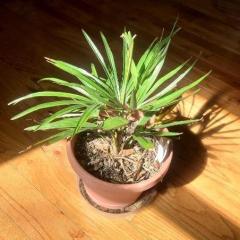
This Cycad was tagged as Cycas Revoluta, clearly it is not, I remember a few years ago it had a different label Macrozamia? For some reason they changed it, does anyone know what this is?

IMG_20150707_141238_1.jpg

  • Upvote 1

Sol Cooper

Hobart Tasmania

42 degrees South

Mild climate - mostly frost free

Posted

Yea, that is a Macrozamia. I am not an expert on macros, but unless it is something much more rare, it looks a lot like a large communis. Tom

  • 1 year later...
Posted

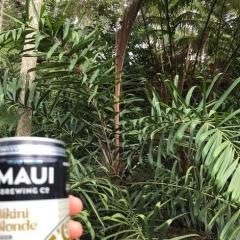
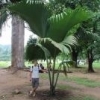
Hi Cycad jungle.  I planted 2 species in my garden that I cannot name. Can you help? Thanks in advance

20170701_131335.jpg

Posted
On 7/8/2015, 7:34:54, cycadjungle said:

Yea, that is a Macrozamia. I am not an expert on macros, but unless it is something much more rare, it looks a lot like a large communis. Tom

Agree.... again, not a specialist on Macrozamia's and no answer on why someone would incorrectly tag it as Cycas revoluta if they had any knowledge of cycads


15 hours ago, Jeff_Cabinda said:

I planted 2 species in my garden that I cannot name. Can you help?

The further back one is from the Cycas genus, but some close ups of both the caudex and leaflets will help.  The closer one is hard to tell without a closer photo (without the closeup photo it does look like Cycas revoluta).  So take closeups of both plants and post.

33.0782 North -117.305 West  at 72 feet elevation

Posted

That front one is revoluta. Back one sort of looks like panzhihuaensis. Where are you located and do you have rare species available in your area? With all these new Cycas from Vietnam, and China, I can't tell a lot of those apart.

  • Upvote 1
Posted
On Sun Jul 02 2017 04:55:35 GMT+0100, Tracy said:

Agree.... again, not a specialist on Macrozamia's and no answer on why someone would incorrectly tag it as Cycas revoluta if they had any knowledge of cycads


The further back one is from the Cycas genus, but some close ups of both the caudex and leaflets will help.  The closer one is hard to tell without a closer photo (without the closeup photo it does look like Cycas revoluta).  So take closeups of both plants and post.

I am located in Cabinda west africa. As far as the one in the back is concerned I have seen old specimen here (4 meters high ans several branches). Must be old and may have been planted by portuguese s before discolouration in 1975. I do not think we have native cycads here. South Africa yes.

Posted

Discolonisation. ..

Posted
2 hours ago, Jeff_Cabinda said:

I am located in Cabinda west africa. As far as the one in the back is concerned I have seen old specimen here (4 meters high ans several branches). Must be old and may have been planted by portuguese s before "discolonisation" in 1975. I do not think we have native cycads here. South Africa yes.

Jeff you should still get a couple of photos, both the caudex and the leaves from a closer perspective.  It's likely someone will be able to provide an id for you on that one.  As far as I know, you are correct that there aren't any native Encephalartos as far north and west as you are in Africa.... at least not discovered to date.

33.0782 North -117.305 West  at 72 feet elevation

Posted

They are native encephalartos in west africa ! Togo ,Ghana ,Benin Congo, Nigeria, Angola.... with sp  barteri, poggei, laurentianus...

  • Upvote 1
Posted
20 hours ago, Tracy said:

Jeff you should still get a couple of photos, both the caudex and the leaves from a closer perspective.  It's likely someone will be able to provide an id for you on that one.  As far as I know, you are correct that there aren't any native Encephalartos as far north and west as you are in Africa.... at least not discovered to date.

Please see below. Even if (tbc) not from here it is very well adapted and withstand drought and heavy rains

20170708_103923.jpg

20170708_103934.jpg

Posted
2 hours ago, yeye said:

i would say cycas thouarsii!

I will second that.  One of the faster growing cycads; I consistently get 2 flushes a year on these even after coning or seeding and I would think Cabinda's climate would be even more favorable. 

33.0782 North -117.305 West  at 72 feet elevation

Create an account or sign in to comment

You need to be a member in order to leave a comment

Create an account

Sign up for a new account in our community. It's easy!

Register a new account

Sign in

Already have an account? Sign in here.

Sign In Now


  • Recently Browsing

    • No registered users viewing this page.
×
×
  • Create New...