Jump to content
  • WELCOME GUEST

    It looks as if you are viewing PalmTalk as an unregistered Guest.

    Please consider registering so as to take better advantage of our vast knowledge base and friendly community.  By registering you will gain access to many features - among them are our powerful Search feature, the ability to Private Message other Users, and be able to post and/or answer questions from all over the world. It is completely free, no “catches,” and you will have complete control over how you wish to use this site.

    PalmTalk is sponsored by the International Palm Society. - an organization dedicated to learning everything about and enjoying palm trees (and their companion plants) while conserving endangered palm species and habitat worldwide. Please take the time to know us all better and register.

    guest Renda04.jpg

Recommended Posts

Posted

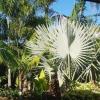
Here are a couple of pics of what I believe to be a dypsis albofarinosa. After a fair bit of rain the new spears seem to have a red tinge which I have never seen before.

Any thoughts?

post-7433-0-52103400-1408871621_thumb.jp

post-7433-0-62760700-1408871701_thumb.jp

post-7433-0-46976500-1408871768_thumb.jp

Posted

Nice plant :)

It seems it has a weeping habit, is it normal with all D.albofarinosa?

We have 10 cm seedlings, I look forward to seeing them growing.

Are they fast?

5809129ecff1c_P1010385copie3.JPG.15aa3f5

Philippe


Jungle Paradise in Sri Lanka


Posted

My albofarinosa seedlings did 4-5 leafs in the first year. One of the faster dypsis i tried so far.

Posted

Very slow Philippe but the white chalky texture is pretty special and worth the wait. One or two people are sceptical it is an albofarinosa but that is what I bought it as and i'm sticking to it.

Posted

That looks like D albofarinosa to me. This species was originally called D baronii "white stem" and first appeared in Australia. Some of that seed/seedlings went to Hawaii and ended up in Jeff Marcus's garden and was described there. But there will be many in QLD gardens originally bought as D baronii.

Millbrook, "Kinjarling" Noongar word meaning "Place of Rain", Rainbow Coast, Western Australia 35S. Warm temperate. Csb Koeppen Climate classification. Cool nights all year round.


Posted

I think us Aussies used to call this palm alba farinosa, I think the Americans ( probably correctly ) call it onilahensis "weeping form". It's a nice specimen Brad!

Posted

Here's a pic of my Dypsis albofarinosa. It was called Dypsis 'white stem' previously. Does this look similar to yours?

post-90-0-49060900-1408950994_thumb.jpg

post-90-0-58437100-1408951038_thumb.jpg

Hawaii Island (Big Island), leeward coast, 19 degrees N. latitude, south Kona mauka at approx. 380m (1,250 ft.) and about 1.6 km (1-mile) upslope from ocean.


No record of a hurricane passing over this island (yet!).  

Summer maximum rainfall - variable averaging 900-1150mm (35-45") - Perfect drainage on black volcanic rocky soil.  

Nice sunsets!

Posted

It looks very similar Al although yours seems to be a much more mature specimen. How old would yours be?

Mine has been in the ground 4 years from a 200ml pot, not sure how that compares to your gallons.

Posted

200mm pot is equal to a 1 gallon

300mm 3 gal

400mm 6 gal

The best time to plant a tree is 20 years ago. The next best time is now...

~ Chinese Proverb


10344842_10152443920736742_914492094660907758_n.jpg

Posted

I think us Aussies used to call this palm alba farinosa, I think the Americans ( probably correctly ) call it onilahensis "weeping form". It's a nice specimen Brad!

I agree. This is an Onily. True Albo has more of a V'ed leaf, the leaflets bend midway down and kind of fall to the front of the leaf. But most importantly they have a white new spear. Hence the old name "Dypsis sp. White Petiole". The new spear above shown has the classic red emerging spear of a droopy Onily.

Len

Vista, CA (Zone 10a)

Shadowridge Area

"Show me your garden and I shall tell you what you are."

-- Alfred Austin

Posted (edited)

I bought this one as a D. Albofarinosa earlier this year. VERY SLOW grower - and sometimes I think it's just at a stall right now, but it does seem to be creeping up a leaf here and there. Most of the day it's in the shade, but in the morning hours it gets filtered sun. I hope to see this one grow up and not kill it. Very attractive 'lacy' delicate and graceful palm when mature I think .

post-10438-0-29745200-1408991299_thumb.j

Edited by Mantarey

-REY

Posted

Dypsis onilahensis and D baronii are a confused group. Dypsis onilahensis has a droopy leaf form and a stiff strongly keeled leaf form. For some reason which I now forget, the taxonomists (back in 2003 roughly) considered what they now call as D albofarinosa distinct from D onilahensis, but they are very closely related. Back before the official description, no one had heard of D albofarinosa. It's possible that after the description, nurseries were calling the weeping onilahensis D albofarinosa. To be honest, sometimes the only way to tell the difference is to wait until it seeds and cut the seed open to see if it has a ruminate endosperm or not. That is often the only difference between one species and another that look identical everywhere else.

Millbrook, "Kinjarling" Noongar word meaning "Place of Rain", Rainbow Coast, Western Australia 35S. Warm temperate. Csb Koeppen Climate classification. Cool nights all year round.


Posted

D albofarinosa is quite distinct from D onilahensis. Not sure how anyone could confuse the two plants once they get size.

Len

Vista, CA (Zone 10a)

Shadowridge Area

"Show me your garden and I shall tell you what you are."

-- Alfred Austin

Posted (edited)

I think there must have been an incorrect leap of faith that Baronii var white petiole was albofarinosa. [ "white stem" was something else?] It surely very strongly resembles droopy onilahensis though seems to produce a lot more stems and is less tolerant of cool conditions for me.

Edited by richnorm
Posted

From Palmpedia,

"Dypsis albofarinosa originated in a commercial lot of seeds of D. baronii exported from Madagascar to Australia in the late 1980s or early 1990s. Several growers and collectors, among them Curt Butterfield of Queensland, Australia and Marcus, recognized that some of the resulting plants differed substantially from D. baronii. They selected out these different plants and grew them on, eventually distributing seeds and seedlings. The species has been erroneously grown under the name D. onilahensis in Australia and D. baronii and D. baronii var. compacta in Hawaii. Marcus has widely distributed this species as Dypsis 'white petiole.' A striking ornamental, the white powder Dypsis grows vigorously to form handsome, rather open clumps of a dozen or more slender stems to five meters tall topped by elegant, gracefully arching, long-pinnate leaves. Long petioles enhance the gracefully arching effect. Most conspicuous and exceptional are the chalky powdery white crownshafts. The powdery white material also initially covers the petiole, rachis, and stems but, unlike the crownshafts, weathers away from these organs. Relatively easy to grow, Dypsis albofarinosa fruits abundantly in cultivation and is easily propagated from seeds. It tolerates shade to nearly full sun in Hawaii. (D. Hodel and J. Marcus. 2004)"

Millbrook, "Kinjarling" Noongar word meaning "Place of Rain", Rainbow Coast, Western Australia 35S. Warm temperate. Csb Koeppen Climate classification. Cool nights all year round.


Posted

I'm pretty happy with the specimen I have, whatever it is. I think it may be an onily now but I have been calling it something else for years I cant get albofarinosa out of my head. Maybe I need to search for a real albo. Thanks for all your input.

  • Like 1
Posted

I bought this one as a D. Albofarinosa earlier this year. VERY SLOW grower - and sometimes I think it's just at a stall right now, but it does seem to be creeping up a leaf here and there. Most of the day it's in the shade, but in the morning hours it gets filtered sun. I hope to see this one grow up and not kill it. Very attractive 'lacy' delicate and graceful palm when mature I think .

attachicon.gifD. Albofarinosa.jpg

I've got one of those and it needs part sun at least to grow. Mine is actually growing and I am cooler than you are. Give it some fertilizer.

Axel at the Mauna Kea Cloudforest Bioreserve

On Mauna Kea above Hilo. Koeppen Zone Cfb (Montane Tropical Cloud Forest), USDA Hardiness Zone 11b/12a, AHS Heat zone 1 (max 78F), annual rainfall: 130-180", Soil pH 5.

Click here for our current conditions: KHIHILO25

Create an account or sign in to comment

You need to be a member in order to leave a comment

Create an account

Sign up for a new account in our community. It's easy!

Register a new account

Sign in

Already have an account? Sign in here.

Sign In Now


  • Recently Browsing

    • No registered users viewing this page.
×
×
  • Create New...