
Skip to content
View in the app

A better way to browse. Learn more.

PalmTalk

A full-screen app on your home screen with push notifications, badges and more.

To install this app on iOS and iPadOS
  1. Tap the Share icon in Safari
  2. Scroll the menu and tap Add to Home Screen.
  3. Tap Add in the top-right corner.
To install this app on Android
  1. Tap the 3-dot menu (⋮) in the top-right corner of the browser.
  2. Tap Add to Home screen or Install app.
  3. Confirm by tapping Install.

WELCOME GUEST

It looks as if you are viewing PalmTalk as an unregistered Guest.

Please consider registering so as to take better advantage of our vast knowledge base and friendly community.  By registering you will gain access to many features - among them are our powerful Search feature, the ability to Private Message other Users, and be able to post and/or answer questions from all over the world. It is completely free, no “catches,” and you will have complete control over how you wish to use this site.

PalmTalk is sponsored by the International Palm Society. - an organization dedicated to learning everything about and enjoying palm trees (and their companion plants) while conserving endangered palm species and habitat worldwide. Please take the time to know us all better and register.

guest Renda04.jpg

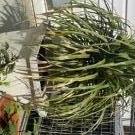
Ravenea rivularis in Zone 8a Washington, DC - Big Box Winter Survivor
Featured Replies

In April 2023 we purchased a Majesty Palm from our local Home Depot in Washington, DC.  For $24.99, it seemed like a cheap way to fill in a bare space of our back yard in the NoMa/Capitol Hill neighborhood in Washington, DC.  They are sold like weeds around here from March on through the warm season.  I quickly learned that many of the big box Ravenea rivularis come as not one larger specimen, but rather 2 or 3 separate trunked specimens--designed to make a more full, filled in look to the plant.

It was a mild year overall, and remained mild well into December.   Outside of a random 2 nights at the end of November (29th=26.3F; 30th=32.4F), where the temperature bottomed out at 26.3F, we stayed relatively mild through December into January, experiencing 2 nights in December where the temp bottomed out at 32.2 and 30.4F respectively.  It suffered no noticeable impacts from the few hours below freezing those particular nights. 

I had already determined that the Ravenea was too large, too full, and too certain to die at some point during the winter, that I ultimately just let it remain in the yard without any sort of cold mitigation efforts, in a corner of our yard facing northwest, however it was obstructed from the brunt of the northern winter winds due to the house.  

The period from January 15-January 22 was, by far, the most impactful on all of our plants.  Though I believe our home to be in one of, if not the warmest neighborhood in the already UHI modified, low elevation urban center of Washington, DC, this stretch was challenging.  According to the weather station in our yard, highs and lows for this period were as follows:

Jan 15 - Hi 51F  Lo 26F

Jan16 - Hi 37F  Lo 23F

Jan 17 - Hi 41F  Lo 20F

Jan 18 - Hi 42 F Lo 25F

Jan 19 - Hi 35F  Lo 30F

Jan 20 - Hi 36F  Lo 24F

Jan 21 - Hi 42F  Lo 21F

Jan 22 - Hi 49F  Lo 22F

From there the temperature climbed considerably to a peak of 83F (80F at DCA) on January 26, the all-time January record in the city's history, along with it, a Dew Point of 68F--what a strange day that was.  It was around this time the extent of damage to the Majesty Palm was apparent.  For better or worse, I pruned the dead/dying brown fronds.  2 out of the 3 trunks appeared to be total losses--though I left what remained of the spears in those trunks, in the remote chance they would come back in the spring.  The only thing remaining was 1 fully grown frond on the front trunk, and one smaller front, growth stunted by the deep cold the previous week.  

From this point forward the palm remained un touched until mid-March, which our last freeze of the winter Feb 15.  Until sometime in April, it wasn't apparent whether it would ultimately survive--mid-March through April typically has wildly fluctuating temperatures, anywhere from the mid-40's at night to 90+ during the days during warm stretches.  The healthy deep green coloration of the Majesty Palm faded to a very light whitish green on the mature frond, to slightly darker green on the newer foliage.   

After a long stretch of very warm to hot days to end April, and into May (86F-95F during the day; 60f-70F at night), the deep green coloration returned to the newer growth that was pushing out from the trunk.  As of May 6, 2024, the spear is a deep green color, and, appears to be very healthy at this point, and it appears ready to push out new growth.

It's also worth noting that a few other Ravenea rivularis remained in their respective locations during the winter in our neighborhood.  The Marrow Hilton Hotel had several in a large planter outside of their entrance.  They only made it to the first snow at the start of the January cold snap, despite looking very healthy (healthier than ours) up to that point.  I don't believe it was the cold, but rather the heavy wet snow that smashed the fronds, and snapped the spears.  Another Ravenea, facing south, and in a large planter next to a corner home along Constitution Ave NE DC, also made it through the winter, and it remains there as of May 6, 2024.  It had yet to be pruned of its damage, and looked in rough shape mid-March when we walked by it one evening, but it did show some newer growth pushing from the center.  That was the first time post-winter we had checked on it.  It's in much better shape now.

I realize that, despite a warmer winter overall, our big box Ravenea's days are likely very limited here.  I was, however, quite surprised that any part of this palm could make it through winter, unassisted, in Washington, DC, even if by the skin of it's teeth.  Most sources online suggest this palm will not tolerate temps consistently below 35F, so I did not have much hope at all for ours.  It is apparent that Ravenea rivularis does posses some adaptability, in the right circumstances, to push through significantly colder temperatures.  Maybe it's worth mentioning that, not only was it an unusually warm winter overall, but it was also much wetter than usual, due in part to the el-nino.  December - January were well above average in terms of rain, with significantly higher humidity than we typically experience.


I will add my information to the hardiness/cold damage information speadsheet.  Has anyone else noticed anything similar to my experience with this particular palm, or any others, that ultimately sustained, and survived substantially lower temperatures than common information on that particular palm would suggests?

45 minutes ago, jwf1983 said:

In April 2023 we purchased a Majesty Palm from our local Home Depot in Washington, DC.  For $24.99, it seemed like a cheap way to fill in a bare space of our back yard in the NoMa/Capitol Hill neighborhood in Washington, DC.  They are sold like weeds around here from March on through the warm season.  I quickly learned that many of the big box Ravenea rivularis come as not one larger specimen, but rather 2 or 3 separate trunked specimens--designed to make a more full, filled in look to the plant.

It was a mild year overall, and remained mild well into December.   Outside of a random 2 nights at the end of November (29th=26.3F; 30th=32.4F), where the temperature bottomed out at 26.3F, we stayed relatively mild through December into January, experiencing 2 nights in December where the temp bottomed out at 32.2 and 30.4F respectively.  It suffered no noticeable impacts from the few hours below freezing those particular nights. 

I had already determined that the Ravenea was too large, too full, and too certain to die at some point during the winter, that I ultimately just let it remain in the yard without any sort of cold mitigation efforts, in a corner of our yard facing northwest, however it was obstructed from the brunt of the northern winter winds due to the house.  

The period from January 15-January 22 was, by far, the most impactful on all of our plants.  Though I believe our home to be in one of, if not the warmest neighborhood in the already UHI modified, low elevation urban center of Washington, DC, this stretch was challenging.  According to the weather station in our yard, highs and lows for this period were as follows:

Jan 15 - Hi 51F  Lo 26F

Jan16 - Hi 37F  Lo 23F

Jan 17 - Hi 41F  Lo 20F

Jan 18 - Hi 42 F Lo 25F

Jan 19 - Hi 35F  Lo 30F

Jan 20 - Hi 36F  Lo 24F

Jan 21 - Hi 42F  Lo 21F

Jan 22 - Hi 49F  Lo 22F

From there the temperature climbed considerably to a peak of 83F (80F at DCA) on January 26, the all-time January record in the city's history, along with it, a Dew Point of 68F--what a strange day that was.  It was around this time the extent of damage to the Majesty Palm was apparent.  For better or worse, I pruned the dead/dying brown fronds.  2 out of the 3 trunks appeared to be total losses--though I left what remained of the spears in those trunks, in the remote chance they would come back in the spring.  The only thing remaining was 1 fully grown frond on the front trunk, and one smaller front, growth stunted by the deep cold the previous week.  

From this point forward the palm remained un touched until mid-March, which our last freeze of the winter Feb 15.  Until sometime in April, it wasn't apparent whether it would ultimately survive--mid-March through April typically has wildly fluctuating temperatures, anywhere from the mid-40's at night to 90+ during the days during warm stretches.  The healthy deep green coloration of the Majesty Palm faded to a very light whitish green on the mature frond, to slightly darker green on the newer foliage.   

After a long stretch of very warm to hot days to end April, and into May (86F-95F during the day; 60f-70F at night), the deep green coloration returned to the newer growth that was pushing out from the trunk.  As of May 6, 2024, the spear is a deep green color, and, appears to be very healthy at this point, and it appears ready to push out new growth.

It's also worth noting that a few other Ravenea rivularis remained in their respective locations during the winter in our neighborhood.  The Marrow Hilton Hotel had several in a large planter outside of their entrance.  They only made it to the first snow at the start of the January cold snap, despite looking very healthy (healthier than ours) up to that point.  I don't believe it was the cold, but rather the heavy wet snow that smashed the fronds, and snapped the spears.  Another Ravenea, facing south, and in a large planter next to a corner home along Constitution Ave NE DC, also made it through the winter, and it remains there as of May 6, 2024.  It had yet to be pruned of its damage, and looked in rough shape mid-March when we walked by it one evening, but it did show some newer growth pushing from the center.  That was the first time post-winter we had checked on it.  It's in much better shape now.

I realize that, despite a warmer winter overall, our big box Ravenea's days are likely very limited here.  I was, however, quite surprised that any part of this palm could make it through winter, unassisted, in Washington, DC, even if by the skin of it's teeth.  Most sources online suggest this palm will not tolerate temps consistently below 35F, so I did not have much hope at all for ours.  It is apparent that Ravenea rivularis does posses some adaptability, in the right circumstances, to push through significantly colder temperatures.  Maybe it's worth mentioning that, not only was it an unusually warm winter overall, but it was also much wetter than usual, due in part to the el-nino.  December - January were well above average in terms of rain, with significantly higher humidity than we typically experience.


I will add my information to the hardiness/cold damage information speadsheet.  Has anyone else noticed anything similar to my experience with this particular palm, or any others, that ultimately sustained, and survived substantially lower temperatures than common information on that particular palm would suggests?

:greenthumb:

Pictures of your specimen? or any others there??..

There have been a few discussions in the Main and Cold Hardy Palms sections of the Forum of Majesties surviving temps in / below the lower 20s from places like Louisiana ...and either Mississippi or Alabama.

While it doesn't get nearly as cold as it can D.C. or in the south, know of several specimens back in San Jose CA. that experience ..at least.. a few nights below 35 each winter,  and the occasional night or 3 bottoming out the 27-30F range ..and survived that w/ barely more than surface / fleeting cosmetic damage..

As far as " On -line " info goes,  i think ..many more times than not.. plant hardiness info is highly skewed to / based off info from a specific location or small region,  rather than scouring for specimens / data on how those specimens grow across a wide area.. 

Royal Poinciana is one -of many- such examples..  More often than not, overall  information -from more sources than not anyway-  is skewed toward how they grow in some place that is always warm, ...like say S. FL. of Hawaii, where as ignoring  ..or including very little reference on   how they grow in either CA,  or here in AZ..  Where they perform well ..even if the overall growth rate might be a tad slower / they can experience a little more cold damage at times compared to specimens in those warmer / ideal areas..

While some things are quite obvious, IE: forget growing a Coconut outdoors in Portland Ore. / Camellias in the low desert here, i personally don't treat 75-85%  of plant hardiness info out on the " Net "  as final word, ..so to say ..seeing it as more of a " sometimes accurate / often times not quite so correct "  assumption to be tested in my particular location,  if so inclined.

Heck, lol there are ( wayy too many ) folks here that are amazed to learn we have native palms / other native " tropical " plant species ..or can grow tropical fruits like  Mangoes and /or Papaya here.

I always think to myself when hearing the " Really!?!, i didn't know... ' response to either of the above mentioned things from locals, ...some who have lived here for all their lives   " How the heck don't you not  know this. Do you ever look around to see what is growing in your neighborhood(s) / growing wild out in X part of the state. Ever talk with  real  plant people? ..or just take advise from the dude / dude -ette at the local big box "

If someone is treating the plant advise they're going to get from 98% of big box folks as gospel, they're being fleeced, Bigly,  lol.


  • Author

Here is a photo from last year in 2023 (Spring--shortly after we got it.)  The other two are from a week or so ago?  Spear is showing, and growing, so I suspect new growth to come.  Temps have been mostly in 70's-80's + this spring, and wet, so temps during the nighttime have stayed a bit more elevated than normal for this early (60's).   As you can see, the damage was extensive, but it survived nonetheless.

Majesty pre-winter 23 1.0.jpeg

Majesty post-winter 24 1.0.jpeg

Majesty post-winter 24 2.0.jpeg

2 hours ago, jwf1983 said:

Here is a photo from last year in 2023 (Spring--shortly after we got it.)  The other two are from a week or so ago?  Spear is showing, and growing, so I suspect new growth to come.  Temps have been mostly in 70's-80's + this spring, and wet, so temps during the nighttime have stayed a bit more elevated than normal for this early (60's).   As you can see, the damage was extensive, but it survived nonetheless.

Majesty pre-winter 23 1.0.jpeg

Majesty post-winter 24 1.0.jpeg

Majesty post-winter 24 2.0.jpeg

Considering your location, that majesty looks fantastic..

Have seen more damage on planted specimens back in the zone 9b / flirting w/ 10A neighborhoods i grew up in  in San Jose..  than on yours.  Aside from the cosmetic damage on it, center spear looks solid.  Might mark it to monitor how quickly it / other new ones that push out this summer move..

W/ the sustained warmth,  humidity / rainfall you're more likely to see through the summer than anywhere in the Bay Area,  i'd anticipate a good burst of growth. 
 

If you haven't looked into any options yet, would recommend finding a good palm fertilizer, specifically one with a high K / Potassium / Magnesium  content ( over 12% K ) and apply 2 or 3X's between now and late September/ early October..  Maybe an application of Iron once a year too ( Majesties = hungry critters.  Applications of higher K ferts have been shown to increase both drought / heat, and cold tolerance as well )  

Agree that longer term, it's days may be numbered, esp. in a pot ( Since pots can cool faster than if planted in the ground )  ...but,  as mentioned, they have survived -to a much larger size- in parts of the south where it can get quite cold occasionally.

So you never know ..you might be one of the first to grow this great palm to a decent size for several years in your area, ..if not longer  if your winters stay mild enough.

As mentioned at the beginning, you're off to a great start so far, imo..
 

  • Author

Thanks for the feedback.  I certainly believe the density of the neighborhood, semi-sheltered location, low elevation below the fall line (about 30 ft), and warmer winters have something to do with it.  Relative to DCA, I average about +4F warmer with regard to maximum and minimum temps, sometimes even more pronounced in the winter.

For whatever it's worth, we've not had an outright loss of any palm to date--accounting for about 10 years.  We have a Trachy f, Sabal m, 4 Cycas r., Phoenix r., Rapis e.,  Beaucarnea recurvata.  Also Quercus virginiana (Close to in range) that came with Spanish Moss that has spread throughout the front and back of our property.  The Ponytail Palm did suffer damage this winter, after 5 winters outside with a zip up, waterproof frost cloth for the coldest nights.  I suspect that the cold, along with the much wetter than usual El Nino pattern this winter was at least partially to blame.  After some traumatic pruning, it's bounced back considerably with lots of new growth.  We typically get 2-3 flushes out of the Sagos each year from May to October.

I keep detailed weather/temperature statistics to try and gather a better understanding of any variability from one year to another.  A hobby like this, in a place like this, at the sort of crossroads of North and South, and the welcome benefit of a strong UHI, I never forget that it's a just a matter of time before a single day, or several consecutive days, wipe out a significant amount of time and effort.  As you mentioned, often the information online about plant hardiness is a bit misleading.  I think the most rewarding aspect of all this is witnessing these small surprises, and just how much certain palm/plant species can adapt and adjust to an otherwise inhospitable environment--if only for a period of time.  Sometimes I imagine myself stuck outside in my yard and without clothes in Washington, DC in January, the temperature dipping below freezing at night, with a strong northwest wind.  Assuming none of my neighbors called the cops, I struggle to imagine myself surviving the night, let alone the winter.  The fight to survive with these plants is something truly incredible.


Any suggestions on a quality fertilizer for the Majesty?  Or brand recommendation?


4 hours ago, jwf1983 said:

Thanks for the feedback.  I certainly believe the density of the neighborhood, semi-sheltered location, low elevation below the fall line (about 30 ft), and warmer winters have something to do with it.  Relative to DCA, I average about +4F warmer with regard to maximum and minimum temps, sometimes even more pronounced in the winter.

For whatever it's worth, we've not had an outright loss of any palm to date--accounting for about 10 years.  We have a Trachy f, Sabal m, 4 Cycas r., Phoenix r., Rapis e.,  Beaucarnea recurvata.  Also Quercus virginiana (Close to in range) that came with Spanish Moss that has spread throughout the front and back of our property.  The Ponytail Palm did suffer damage this winter, after 5 winters outside with a zip up, waterproof frost cloth for the coldest nights.  I suspect that the cold, along with the much wetter than usual El Nino pattern this winter was at least partially to blame.  After some traumatic pruning, it's bounced back considerably with lots of new growth.  We typically get 2-3 flushes out of the Sagos each year from May to October.

I keep detailed weather/temperature statistics to try and gather a better understanding of any variability from one year to another.  A hobby like this, in a place like this, at the sort of crossroads of North and South, and the welcome benefit of a strong UHI, I never forget that it's a just a matter of time before a single day, or several consecutive days, wipe out a significant amount of time and effort.  As you mentioned, often the information online about plant hardiness is a bit misleading.  I think the most rewarding aspect of all this is witnessing these small surprises, and just how much certain palm/plant species can adapt and adjust to an otherwise inhospitable environment--if only for a period of time.  Sometimes I imagine myself stuck outside in my yard and without clothes in Washington, DC in January, the temperature dipping below freezing at night, with a strong northwest wind.  Assuming none of my neighbors called the cops, I struggle to imagine myself surviving the night, let alone the winter.  The fight to survive with these plants is something truly incredible.


Any suggestions on a quality fertilizer for the Majesty?  Or brand recommendation?


 That's pretty good if you've been able to grow both Beaucarnea and roebelinii w/ out too much trouble for a number of years.  Agree, a wetter than normal winter might explain any damage you saw on the Pony Tail.. I say that because there are a couple gardens here a tad outside of where you'd think they could grow, ..but they do, despite those areas sometimes seeing lows in the middle ..or lower 20s for a couple days, and/ or the occasional dusting to 1-3" of Snow. Might not get as cold as D.C. might at times, but ..definitely not a plant which can only be grown zone 9B+ areas..

Agree too that yes, in more marginal areas ..and even in the more " ideal " of places, a bad winter or two is all it takes to set things back -to whatever  degree-  That said, if things are getting warmer, overall, over time,  even 8 out of 10 of the most extreme cold spells will become milder in time.. So that, say, in 2125, an " extreme " cold spell in Phoenix, might see temps, esp. in the cooler parts of town, not drop any lower than say 32F, where as ..not too long ago, some areas on the outskirts of town saw a couple nights in the lower 20s / high teens during the last nastier cold spell..

Increasing sprawl / development certainly contributes to an UHI effect any and everywhere too..


The " try standing outside for X # of hours / days " Clothed ..or proudly nude, is a great analogy  and something i've thought about when discussing the adaptability of various plants to various climate- related factors ...Really Cold night(s) in say D.C. or Kansas, ...or enduring 3+ months of 105-120F heat, in full sun, provided very little -if any- extra water for example. 

If after sitting in one spot, in that kind of heat ( and sun, )  for 8-14 hours  you're scraping the cusp of very serious heat stroke, and so burnt that your eyes are swelled shut / exposed areas already blistering, how do you think plants ..which can't move ( ..unless transplanted ) through their entire life handle the same exposure, esp. those plants that didn't evolve to handle that kind of torture? ..and not just one day of that,  but several months / decades, -each  -year.

As for Fertilizers, a palm / palm and tropical special with the suggested 8-2-12 ratio is good..

As for a high K source, not sure if either product line is sold back there ..Hopefully one or both are... but, Both E.B Stone and Down To Earth sell a high K product..  E.B. Stone's high K is listed as " Sul-Po-Mag " While Down To Earth's is Langbeinite,  a natural source of Potassium.  While not listed as such, Langbeinite also contains Sulfur and Magnesium.. ..So it's essentially the same thing as what E.B. stone offers..

Down To Earth is also a great source for single - source organic fertilizer components like Azomite, Crab and Oyster Shell meal, Guano, etc..  May not be an issue where you're located, but, Crab / Shrimp / Lobster and Oyster shell meal has been shown to reduce the amount of harmful nematodes in effected soils.. Oyster Shell is a good, natural Calcium source as well..

While i've never worked for either company,  have used products from both E.B stone and D.T.E. for years with what i'd consider excellent results..  Only trouble w/ some of the Organics is they can sit on top of the soil surface when applied. Recommend mixing into to soil -just a little-  to avoid that minor hang up, if you went that route.

Create an account or sign in to comment

Account

Navigation

Configure browser push notifications

Chrome (Android)
  1. Tap the lock icon next to the address bar.
  2. Tap Permissions → Notifications.
  3. Adjust your preference.
Chrome (Desktop)
  1. Click the padlock icon in the address bar.
  2. Select Site settings.
  3. Find Notifications and adjust your preference.