
Skip to content
View in the app

A better way to browse. Learn more.

PalmTalk

A full-screen app on your home screen with push notifications, badges and more.

To install this app on iOS and iPadOS
  1. Tap the Share icon in Safari
  2. Scroll the menu and tap Add to Home Screen.
  3. Tap Add in the top-right corner.
To install this app on Android
  1. Tap the 3-dot menu (⋮) in the top-right corner of the browser.
  2. Tap Add to Home screen or Install app.
  3. Confirm by tapping Install.

WELCOME GUEST

It looks as if you are viewing PalmTalk as an unregistered Guest.

Please consider registering so as to take better advantage of our vast knowledge base and friendly community.  By registering you will gain access to many features - among them are our powerful Search feature, the ability to Private Message other Users, and be able to post and/or answer questions from all over the world. It is completely free, no “catches,” and you will have complete control over how you wish to use this site.

PalmTalk is sponsored by the International Palm Society. - an organization dedicated to learning everything about and enjoying palm trees (and their companion plants) while conserving endangered palm species and habitat worldwide. Please take the time to know us all better and register.
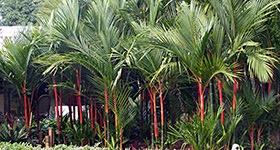
guest Renda04.jpg

Encephalitis laurentianus?

Featured Replies

Was wondering if I have this labeled correctly and any information on growing conditions?

B4E6A0AC-3C0E-405C-BF0C-4AAA59A04B31.jpeg

That looks correct to me.  I would want to provide some afternoon shade for that in your desert summers.  I may be incorrect on how much sun and temperatures into the teens it can handle but will defer to the experience of your fellow inhabitants of the Phoenix area.  The propensity of this species to flush anytime of year as opposed to mostly in spring and summer will actually work in your favor.  It will obviously be most tender when flushing.  They get big!  Flushes when in the ground with mine started increasing leaf length by about 1/3 with each flush and gradually increasing the number of leaves per flush too.  I would also avoid wind prone spots since mature leaves can be 14 feet tall.   To minimize the footprint,  I now remove the prior flush as the new flush leaves are partially emerging.  The prior flush starts to bend down and spread as the new one emerges, which would create a large footprint. 


33.0782 North -117.305 West  at 72 feet elevation

They develop a nice upright appearance. 

20230203_073519.jpg

20230203_073547.jpg

33.0782 North -117.305 West  at 72 feet elevation

That looks like a Laurentianus to me, though I did get fooled on one smaller "Laurentianus" that ended up growing into a Whitelockii/Ituriensis/Equatorialis type.  In my case that was fine, because the Whitelockii types are quite a bit more cold hardy than Laurentianus.  In temperatures from 24-30F with and without frost, my 9 in ground Whitelockii types took variable leaf damage but were never completely defoliated.  My 7 Laurentianus in ground were generally defoliated every time.  So if you get frequent freezes or frosts then some canopy may be a good idea...or plant it somewhat near the house?

Looks correct for Laurentianus.  I never got one.  I don't believe it would make it outdoors here, and that's just too much space to give away in a greenhouse.

If I lived in Hawaii, I'd have a row of them lining the driveway!!

  • Author

@GeneAZ what do you think is the problem too much heat not enough humidity or all of the above?

Winds are hard on these out here in inland so cali but they grow fast. I have 2 planted that I got from the Sparkman collection very nice plants 

Name should be Encephalartos laurentianus.

Encephalitis refers to inflammation of the brain.

On 2/3/2023 at 2:52 PM, 96720 said:

@GeneAZ what do you think is the problem too much heat not enough humidity or all of the above?

I don't think our heat is any problem.  Or the lower humidity.  Of course, they could never take the direct sun from July to September.

They'll make it here but the leaves always look ratty and discolored and misshapen from various environmental things.

It might be the roots getting under 65 F or staying there for months at a time in winter.  They are from a steamy wet place in the Congo with no real seasons.  

4 hours ago, GeneAZ said:

I don't think our heat is any problem.  Or the lower humidity.  Of course, they could never take the direct sun from July to September.

They'll make it here but the leaves always look ratty and discolored and misshapen from various environmental things.

It might be the roots getting under 65 F or staying there for months at a time in winter.  They are from a steamy wet place in the Congo with no real seasons.  

Bear in mind, your plant doesn't look that bad at all.  There's some older crispy tips, but that's not anything to fret over.  It could use a gentle feed.

Create an account or sign in to comment

Account

Navigation

Configure browser push notifications

Chrome (Android)
  1. Tap the lock icon next to the address bar.
  2. Tap Permissions → Notifications.
  3. Adjust your preference.
Chrome (Desktop)
  1. Click the padlock icon in the address bar.
  2. Select Site settings.
  3. Find Notifications and adjust your preference.