Skip to content
View in the app

A better way to browse. Learn more.

PalmTalk

A full-screen app on your home screen with push notifications, badges and more.

To install this app on iOS and iPadOS
  1. Tap the Share icon in Safari
  2. Scroll the menu and tap Add to Home Screen.
  3. Tap Add in the top-right corner.
To install this app on Android
  1. Tap the 3-dot menu (⋮) in the top-right corner of the browser.
  2. Tap Add to Home screen or Install app.
  3. Confirm by tapping Install.

WELCOME GUEST

It looks as if you are viewing PalmTalk as an unregistered Guest.

Please consider registering so as to take better advantage of our vast knowledge base and friendly community.  By registering you will gain access to many features - among them are our powerful Search feature, the ability to Private Message other Users, and be able to post and/or answer questions from all over the world. It is completely free, no “catches,” and you will have complete control over how you wish to use this site.

PalmTalk is sponsored by the International Palm Society. - an organization dedicated to learning everything about and enjoying palm trees (and their companion plants) while conserving endangered palm species and habitat worldwide. Please take the time to know us all better and register.

guest Renda04.jpg

Ponytail Palm Problem

Featured Replies

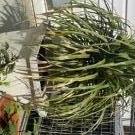
Hello, I’m hoping someone may be able to identify the issue with our Ponytail Palm.  We keep this guy outside about 10 months, and move inside sometime in December through February.  It’s grown very much over the last year and a half that we’ve had it, and we repotted it in April of this year.  Everything had looked great until we noticed something  looking like yellow and brown burning on the leaves. See photos below… I can’t figure out what is wrong here. We have had quite a bit of rain in our part of town the last 40 days or so. It’s weird, because areas around us have not been too far above normal rainfall, but we’ve had close to or over 20 inches of rain during that time. That said, we otherwise never water unless it’s been a long while, and it’s very dry soil. These were all pop up downpours, and other than those short intense storms, we’ve had normal summer average temps and sun, around 90-93 during the day, and 74-77 degrees at night during that time.  Today when we went to inspect the Ponytail Palm we noticed what you see in the pictures, but the soil was completely dry down about two inches to three inches at least. The caudex is NOT soft to the touch, so I’m not sure if it’s root rot at all, and the burns/yellow/brown on the leaves all appear to be on new growth. Any idea what this could be?E87426DB-480C-4C72-84D7-9A9F6430C58C.thumb.jpeg.a1a620057bfb74e7895e6621ba2916a9.jpeg

A46BBF70-FD71-47DC-AD07-990C9FB4B83E.jpeg

B7384F23-95A8-4797-9387-4D0DD2F67880.jpeg

563A6810-F21C-4642-863B-A6AF474D4428.jpeg

8146B888-9123-450C-BC8D-7FAED540561F.jpeg

Looks light bud rot. Something like insects or chemicals can lead to fungus infection. Pour some hydrogen peroxide in the infected area. Once all bubbling has ceased, rinse it out with clean water. Keep it dry after that for a few days. Pour more hydrogen peroxide in to see if it bubbles again. Repeat the process as needed. It should recover in a few days.

Hi 80˚, Lo 72˚ cloudy with light rain


Casas Adobes - NW of Tucson since July 2014

formerly in the San Carlos region of San Diego

  • 2 weeks later...
  • Author

Do we need the 30% hydrogen peroxide, or will the diluted 3% suffice? 

6 hours ago, jwf1983 said:

Do we need the 30% hydrogen peroxide, or will the diluted 3% suffice? 

Any percentage should work, just remember that hydrogen peroxide turns into water, so dry out in between applications.

Palms - 1 Bismarckia nobilis, Butia odorataBxJ, 4 BxSChamaerops humilis, 1 Chamaedorea cataractarum, 1 Chamaedorea elegans, 1 Chamaedorea microspadix1 Chamaedorea radicalis1 Hyophorbe verschaffeltiiLivistona chinensis1 Livistona nitida, 1 Phoenix canariensis2 Phoenix roebelenii, 1 Phoenix sylvestris, Ravenea rivularis1 Rhapis excelsa1 Sabal bermudana, Sabal palmetto, 1 Sabal minor, 2 Syagrus romanzoffiana, Trachycarpus fortunei4 Washingtonia robusta
Total: 37

Create an account or sign in to comment

Account

Navigation

Configure browser push notifications

Chrome (Android)
  1. Tap the lock icon next to the address bar.
  2. Tap Permissions → Notifications.
  3. Adjust your preference.
Chrome (Desktop)
  1. Click the padlock icon in the address bar.
  2. Select Site settings.
  3. Find Notifications and adjust your preference.