Skip to content
View in the app

A better way to browse. Learn more.

PalmTalk

A full-screen app on your home screen with push notifications, badges and more.

To install this app on iOS and iPadOS
  1. Tap the Share icon in Safari
  2. Scroll the menu and tap Add to Home Screen.
  3. Tap Add in the top-right corner.
To install this app on Android
  1. Tap the 3-dot menu (⋮) in the top-right corner of the browser.
  2. Tap Add to Home screen or Install app.
  3. Confirm by tapping Install.

WELCOME GUEST

It looks as if you are viewing PalmTalk as an unregistered Guest.

Please consider registering so as to take better advantage of our vast knowledge base and friendly community.  By registering you will gain access to many features - among them are our powerful Search feature, the ability to Private Message other Users, and be able to post and/or answer questions from all over the world. It is completely free, no “catches,” and you will have complete control over how you wish to use this site.

PalmTalk is sponsored by the International Palm Society. - an organization dedicated to learning everything about and enjoying palm trees (and their companion plants) while conserving endangered palm species and habitat worldwide. Please take the time to know us all better and register.
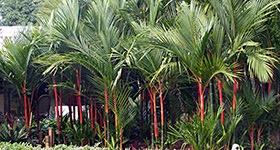
guest Renda04.jpg

Dypsis onilahensis

Featured Replies

this is just a baby, no protection, right near the Baronii that is 3x its size and got damaged...

24 degrees

post-33-1168907597_thumb.jpg

Dave


Riverside, CA Z 9b

1700 ft. elevation

approx 40 miles inland

Mine as well probably a five gallon size not completely burnt but not looking very happy.

Forgot to mention got damaged on sat nite with a low of 28.

San Marcos CA

Have a 5 gal. size in the ground which "suckered" (or internally divided) this year. Parent plant--moderate burning. "Pup" --untouched, so far. Wierd.

Bret

Bret


Coastal canyon area of San Diego


"In the shadow of the Cross"

26.5F low. My two 12" tall D. onilahensis in the ground and exposed are showing no visible damage.

Jim in Los Altos, CA  SF Bay Area 37.34N- 122.13W- 190' above sea level

zone 10a/9b

sunset zone 16

300+ palms, 90+ species in the ground

Las Palmas Design

Facebook Page

Las Palmas Design & Associates

Elegant Homes and Gardens

Serious damage (70%) in pots after two nights of 25 FF.

dave

Let's keep our forum fun and friendly.

Any data in this post is provided 'as is' and in no event shall I be liable for any damages, including, without limitation, damages resulting from accuracy or lack thereof, insult, or lost profits or revenue, claims by third parties or for other similar costs, or any special, incidental, or consequential damages arising out of my opinion or the use of this data. The accuracy or reliability of the data is not guaranteed or warranted in any way and I disclaim liability of any kind whatsoever, including, without limitation, liability for quality, performance, merchantability and fitness for a particular purpose arising out of the use, or inability to use my data. Other terms may apply.

no damage at 29

Don_L    Rancho CUCAMONGA (yes it does exist) 40 min due east of Los Angeles

             USDA Zone 10a

July Averages: Hi 95F, Low 62F

Jan Averages: Hi 68F, Low 45F

About 50% damage with low of 24F-26F for several nights.  Small, approx 10".  No frost.

 San Francisco Bay Area, California

Zone 10a

27F with some overhead protection, half the night- no damage

Larger specimen, four feet and more on two trunks. Did not get damaged at 27F.

Gary

Rock Ridge Ranch

South Escondido

5 miles ENE Rancho Bernardo

33.06N 117W, Elevation 971 Feet

No damage in Modesto... slight overhead protection from a cherimoya tree.

Official Modesto temps... 23f.... my garden thermometer temps  26f

Jeff

Modesto, CA USDA 9b

July/August average 95f/63f

Dec/Jan average 55f/39f

Average lowest winter temp 27f

Record low temp 18f

Record high temp 113f

  • 3 weeks later...

Mine has since become part of the ever increasing mulch pile. This freeze is getting worse and worse for me  I am most likely down to 50% of my in ground palms half have been lost or not looking very promising.

San Marcos CA

  • 2 weeks later...

Sadly, mine is about gone now.  I think I need a bigger one now....

 San Francisco Bay Area, California

Zone 10a

  • 4 months later...

Temps of 0 to -1.5`C on three nights with frost, overhead cover: Spotting of some leaves

Carambeí, 2nd tableland of the State Paraná , south Brazil.

Alt:1030m. Native palms: Queen, B. eriospatha, B. microspadix, Allagoptera leucocalyx , A.campestris, Geonoma schottiana, Trithrinax acanthocoma. Subtr. climate, some frosty nights. No dry season. August: driest month. Rain:1700mm


I am seeking for cold hardy palms!

  • 7 months later...

One plant, 5' OA height

22f, multiple hours and nights below freezing..next to adobe wall, near pool.

50% leaf burn

Fully recovered

If global warming means I can grow Cocos Nucifera, then bring it on....

  • 11 months later...

Two nights at 32 one at 34 last two with heavy frost. I piled mulch up to the growing point and left the fronds exposed. No damage at all. The heliconia on each side is fried.

With a tin cup for a chalice

Fill it up with good red wine,

And I'm-a chewin' on a honeysuckle vine.

Last year I lost one 1gal (I think upright form) planted out in a protected area with a 15-hour, 23.3F event. This year a similar-sized 'droopy' form in a somewhat less-protected area appears to have survived a similar onslaught, 14.5 hours and low of 24.1F, as well as a 10-hour, 27F event, and a half-dozen other slightly less severe freezes/frosts. Probably 75% leaf-burn but I mulched the bud-area for safety and hopefully next year the plant will have some more fortitude. It looks as though larger plants can handle mid-20s without too much trouble. But as juvies they obviously are not so easy...and am hoping that in its second year it will grow faster than a snail's pace.

Michael Norell

Rancho Mirage, California | 33°44' N 116°25' W | 287 ft | z10a | avg Jan 43/70F | Jul 78/108F avg | Weather Station KCARANCH310

previously Big Pine Key, Florida | 24°40' N 81°21' W | 4.5 ft. | z12a | Calcareous substrate | avg annual min. approx 52F | avg Jan 65/75F | Jul 83/90 | extreme min approx 41F

previously Natchez, Mississippi | 31°33' N 91°24' W | 220 ft.| z9a | Downtown/river-adjacent | Loess substrate | avg annual min. 23F | Jan 43/61F | Jul 73/93F | extreme min 2.5F (1899); previously Los Angeles, California (multiple locations)

I gave my Farther-In-Law a small plant, about 8" tall in a pot and told him, he could try it outside when it is larger. He has left it outside this winter and it is now, unsurprisingly, dead. It did, however, take several freezes prior to it's decline with temperatures down to -3°C/27°F not seeming to be a problem. When we had unusually low temperatures in early January though, it died almost immediately.

]

Corey Lucas-Divers

Dorset, UK

Ave Jul High 72F/22C (91F/33C Max)

Ave Jul Low 52F/11C (45F/7C Min)

Ave Jan High 46F/8C (59F/15C Max)

Ave Jan Low 34F/1C (21F/-6C Min)

Ave Rain 736mm pa

Create an account or sign in to comment

Account

Navigation

Configure browser push notifications

Chrome (Android)
  1. Tap the lock icon next to the address bar.
  2. Tap Permissions → Notifications.
  3. Adjust your preference.
Chrome (Desktop)
  1. Click the padlock icon in the address bar.
  2. Select Site settings.
  3. Find Notifications and adjust your preference.