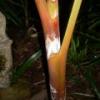
Last winter i put a temporary plasic dome around it. We had a very cool but wet summer summer this year but as you will see from the pics its certainly no slow grower. The small Raphia palms in 8* pots beside the Pigafetta are larger than when the Pigafetta went inground. I planted another Pigafetta 20 mtrs away which got the sun later in the morning and less sun overall, it died as soon as winter approached last year. This Pigafetta is out in the full open here in the cool subtropics on a NE slope. Sun, Sun, Sun and plenty of food and water, absolutely. Here the pics and in one ,the dog is showing the thickness of the mulch.
Pigafetta Filaris 15mths inground
#1
Posted 05 April 2012 - 02:25 AM
Last winter i put a temporary plasic dome around it. We had a very cool but wet summer summer this year but as you will see from the pics its certainly no slow grower. The small Raphia palms in 8* pots beside the Pigafetta are larger than when the Pigafetta went inground. I planted another Pigafetta 20 mtrs away which got the sun later in the morning and less sun overall, it died as soon as winter approached last year. This Pigafetta is out in the full open here in the cool subtropics on a NE slope. Sun, Sun, Sun and plenty of food and water, absolutely. Here the pics and in one ,the dog is showing the thickness of the mulch.
#2
Posted 05 April 2012 - 04:27 AM
Tasmania ,Australia. 42 " south
Cool Maritime climate with no extremes of temperature.
Dry sunny summer ,winter and spring rain
Rec low 27 f (1972) rec high 102 f (1975)
Average winter high 55f 13c
Average Winter low 42f 6 c
Average winter lowest temperature 32f 0c
#3
Posted 05 April 2012 - 05:33 AM
Peachy (the eternal optimist)
27.35 south.
Warm subtropical, with occasional frosts.
#4
Posted 05 April 2012 - 11:59 AM
I'm going to try again in another area of the property (maybe near the waterfall) and hope for the best. These are definitely the fastest growing palms I have ever grown. Bentinckia nicobarica is the second fastest for me.
Are you sure it's P. filaris? It looks exactly like mine at that stage which are supposed to be P. elata. I thought P. filaris had whiter spines? I never could tell them apart...
Jeff Anderson
Escazú, Costa Rica
#5
Posted 05 April 2012 - 12:08 PM
Beautiful palm, and it's getting ready to take off! It'll be a monster in no time!
Bo-Göran
PS to Jeff (and not meaning to get off topic here
http://lundkvistpalmgardencentral.com
#6
Posted 05 April 2012 - 12:28 PM
Pete,
Beautiful palm, and it's getting ready to take off! It'll be a monster in no time!![]()
Bo-Göran
PS to Jeff (and not meaning to get off topic here), have you tried Actinorhytis calapparia? I have found them to be slightly faster growers than B. nicobarica. The Clinostigma "Hawaiian hybrid" is even faster, but might be a tough one to get hold of.
Bo, I have not tried A. calapparia. I do have Clinostigma ponopense, samoense, and savoryanum, but not the hybrid (maybe I can eventually make my own hybrid!). My Clinostigma are all pretty small right now so I can't judge their growth rate yet.
Jeff Anderson
Escazú, Costa Rica
#7
Posted 05 April 2012 - 12:37 PM
Pigafetta elata - 7 ft
Clinostigma "HH" - 5 ft
Actinorhytis calapparia - 4 ft
Bentinckia nicobarica - 3.5 ft
C. ponapense & samoense - 2.5 ft (savoryanum is definitely slower)
This is NOT a list of the palms that are on the fast side, only brought up these since they came up in the discussion here. There are many others that will add between 2 and 3.5 ft of trunk per year; Euterpes, Bactris, various Dypsis (madagascariensis and pembana come to mind), Archontophoenix, Carpentaria and a whole bunch of others that I just didn't think of.
http://lundkvistpalmgardencentral.com
#8
Posted 05 April 2012 - 01:55 PM
Jeff, this is the less tender of the 2 Pigafettas which i understand being Filaris? Or is it the other way around? Glad it likes it here and Im impressed with its growth rate. Pete
Edit...Jeff, your right, Elata this must be, as Filaris is more tender.
#9
Posted 05 April 2012 - 02:05 PM
#10
Posted 05 April 2012 - 02:16 PM
#11
Posted 05 April 2012 - 02:19 PM
Mike, i would assume this would have to be Elata as Jeff and yourself has mentioned because of it being Less tender..But, i do remember discussing the names with Teresa and she did say, good luck that is the least tender of the twoPete ,i have 5 piggies in the ground at the moment,4 P.elata and 1 P.filaris(also from Utopia),but i'm worried after looking at your photos that the P filaris might actually be another P elata
.Did it always have those black spines as a seedling or has it recently started to change?.As P filaris gets older it's supposed to develope more white on the leaf base and have golden spines as opposed to P.elata which have black spines. Could you shed some light on this as i might have bought the same plant at Teresa's only for it to turn out to be another P elata...cheers Mike Green(Newcal)
#12
Posted 05 April 2012 - 02:29 PM
#13
Posted 05 April 2012 - 03:02 PM
Regards, Ari
Darwin, NT, Australia
-12°32'53" 131°10'20"
#14
Posted 05 April 2012 - 11:56 PM
Pete ,i have 5 piggies in the ground at the moment,4 P.elata and 1 P.filaris(also from Utopia),but i'm worried after looking at your photos that the P filaris might actually be another P elata
.Did it always have those black spines as a seedling or has it recently started to change?.As P filaris gets older it's supposed to develope more white on the leaf base and have golden spines as opposed to P.elata which have black spines. Could you shed some light on this as i might have bought the same plant at Teresa's only for it to turn out to be another P elata...cheers Mike Green(Newcal)
Mike, they are easy to tell apart...
After enduring temps of 10c the black piggie is green and the white piggie has a name change to 'brown piggie'...
Your P.elata looks good Pete!
Daryl
Gold Coast Hinterland, Queensland 28S
Mild Humid Subtropical climate
Temp Extremes 4C-42C
Rainfall - not consistent enough!
0 user(s) are reading this topic
0 members, 0 guests, 0 anonymous users