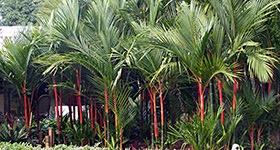
Arenga micrantha
#1
Posted 16 January 2007 - 09:13 PM
Norman Oklahoma
Zach- Meteorology Major @ OU
#2
Posted 18 January 2007 - 08:50 AM
I am planting a couple here in Gainesville, FL this spring.
Gives me hope that it stands a decent chance.
Please let us know if it starts showing damage.
Gainesville, Florida
#3
Posted 18 January 2007 - 08:20 PM
Norman Oklahoma
Zach- Meteorology Major @ OU
#4
Posted 21 January 2007 - 04:13 AM
#5
Posted 31 January 2007 - 05:53 PM
Dick
#6
Posted 31 January 2007 - 06:40 PM
Mine are both doing great. I see very little damage. Mine are about 3 gallon size and they are all doing great.
Thats to bad of a loss. They are extremely hard to find for me. Hope they do alright. In the wild I hear that they take frost and sometimes snow.
Norman Oklahoma
Zach- Meteorology Major @ OU
#7
Posted 01 February 2007 - 04:41 AM
Keep a close eye on your A. micrantha. Mine showed no damage until I noticed yesterday that the two lower fronds had gone into rapid decline and it only has 3 fronds. The damage showed up in only the last couple of days. I didn't give either of my A. micranthas any protection, since I assumed they were more cold hardy.
From the lack of reports, I assume not many have A. micrantha. If anyone has one, please send in a report.
Dick
#8
Posted 01 February 2007 - 03:27 PM
Almost no rain here in January.
Modesto, California
Sunset Zone 14 USDA 9b
Low Temp. 19F/-7C 12-20-1990
High Temp. 111F/43C 07-23-2006
Annual Average Precipitation 13.12 inches/yr.
#9
Posted 08 February 2007 - 11:42 PM
#10
Posted 09 February 2007 - 12:27 AM
#11
Posted 11 February 2007 - 11:37 PM
Norman Oklahoma
Zach- Meteorology Major @ OU
#12
Posted 11 January 2008 - 07:01 AM
Low of 21 F, 10 hours at freezing temps.
3 days of freezing temps.
Substantial overhead protection. Little or no frost.
15 mph winds.
90% with all mature leaves pretty much toast. As described above, damage takes a couple of weeks to really show up.
New unopened spear, which is about the same lenghth as the last mature leaf, appears to be undamaged.
This plant is about 4ft OA.
Hopefully this one will recover in the summer. Last summer it produced 3 new leaves.
Also, temps were into the low 80s(F) the week before and the new spear was pushing out.
If plants do indeed "harden" off, this plant was probably "soft".
Gainesville, Florida
#13
Posted 13 January 2008 - 07:00 AM
I replanted ( a few years ago). hoping for better times but it grows real slow.
Best regards,
Ed
#14
Posted 14 January 2008 - 06:55 AM
It seems this advective freeze was a bit harsher on my marginal stuff. I have Agave augustifolias that usually only show damage in the upper teens (F) showing some damage. The damage on my agaves didn't show up until two weeks later.
I should note that this A. micrantha has seen temps down to 22F in a radiational freeze and showed no damage.
Now the spear is looking a bit "odd" but one leaf still is looking more or less alive. The spear actually looks like it started growing again during the warm weather we had this past week.
Gainesville, Florida
#15
Posted 24 January 2008 - 08:03 AM
Gainesville, Florida
#16
Posted 04 March 2008 - 08:16 AM
Also,
Ed, sorry for calling you ROB. I noticed it awhile ago but not quick enough to edit it.
Gainesville, Florida
#17
Posted 07 March 2008 - 09:41 AM
A. engleri have come back from 10F ---- These make big beautiful clumps
#18
Posted 25 July 2008 - 07:36 AM
Gainesville, Florida
#19
Posted 03 August 2008 - 05:42 PM
Jason
My A. micrantha survived and has put out its first new leaf since the freeze.
Min. temp Jan 2007: 28.1 deg. F (-2.2 deg. C)
Min. temp winter 2008: 34.7 deg. F (1.5 deg. C)
USDA Zone 10A since 2000
#20
Posted 27 January 2009 - 08:21 PM
Big Pine Key, Florida | 24° 40' N 81° 21' W | elev. 3 ft.
Zone 11b | Calcareous substrate
60-year avg annual min. approx. 48F
Jan avg approx. 65/75F, July 83/88F
Historical extreme low: approx. 41F
Natchez, Mississippi | 31° 33' N 91° 24' W | elev. 220 ft.
zone 9a | Downtown/river-adjacent microclimate | Loess substrate
80-year avg annual min. approx. 23F / Last 7 winters: 24 | 27 | 22.8 | 23.3 | 24.1 | 18.4F | 22.7F (2010-11) / airport/outlying area: 8b/19F annual min
Jan avg approx. 43/61F, July 73/93F
Historical extreme lows: 2.5F 1899; 4F 1940; 5F 1989
#21
Posted 17 February 2009 - 07:28 AM
Nursery down the street was selling 35 gallon A. engleri's, big full plants about 10 ft OA in the pot for $200. A friend of mine picked one up one of these on one of the 80F days we had right before the worst freeze of the year. His A. engleri was under canopy and not touched.
will not plant any more A. micranthas out up here.
Gainesville, Florida
#22
Posted 18 February 2009 - 05:35 AM
Dick
#23
Posted 23 April 2010 - 06:51 AM
Gainesville, Florida
#24
Posted 03 June 2010 - 01:36 PM
Austin, Texas, Zone 8b/9a
#25
Posted 13 September 2010 - 12:42 PM
Regards
Ravenna , Italy
USDA 8a\b
#26
Posted 11 December 2010 - 11:14 AM
I have written off A. micrantha for my climate. Not only are they not that cold hardy, but I had one with a nice spear about to open last summer, and we had a heat wave and the spear was cooked, and that in part shade too. It had taken a year to grow the damn spear. I think they like warmer nights and higher humidity than I have.
Dick
Arenga micrantha at the San Francisco Botanical Garden is slow but very successful. They are planted in shady spots, have flawless dark green leaves, and appear undaunted by the light frosts experienced (probably have seen 28F minimum). They put out 2 leaves per growing point per year. Much better than A. engleri, which sits unmoving all year until it finally collapses.
I think this plant tolerates cool humid nights very well, whatever its other tolerances may be. Hot and dry sounds lethal.
Jason
Inner Sunset District
San Francisco, California
Sunset zone 17
USDA zone 10a
21 inches / 530mm annual rainfall, mostly October to April
Humidity averages 60 to 85 percent year-round.
Summer: 67F/55F | 19C/12C
Winter: 56F/44F | 13C/6C
40-year extremes: 96F/26F | 35.5C/-3.8C
#27
Posted 11 December 2010 - 04:19 PM
Mines not doing well here either Dick. New spears open and look good, then are burned by both frost or the slightest amount of sun getting through.
I have written off A. micrantha for my climate. Not only are they not that cold hardy, but I had one with a nice spear about to open last summer, and we had a heat wave and the spear was cooked, and that in part shade too. It had taken a year to grow the damn spear. I think they like warmer nights and higher humidity than I have.
Dick
Arenga micrantha at the San Francisco Botanical Garden is slow but very successful. They are planted in shady spots, have flawless dark green leaves, and appear undaunted by the light frosts experienced (probably have seen 28F minimum). They put out 2 leaves per growing point per year. Much better than A. engleri, which sits unmoving all year until it finally collapses.
I think this plant tolerates cool humid nights very well, whatever its other tolerances may be. Hot and dry sounds lethal.
Jason
Modesto, California
Sunset Zone 14 USDA 9b
Low Temp. 19F/-7C 12-20-1990
High Temp. 111F/43C 07-23-2006
Annual Average Precipitation 13.12 inches/yr.
#28
Posted 17 December 2010 - 11:51 AM
#29
Posted 21 December 2010 - 10:29 PM
#30
Posted 15 December 2011 - 10:38 AM
Mine has been down to around -2.5°C many times and sits in full sun and has never been damaged by anything.
Possibly the toughest palm I grow.
#31
Posted 15 January 2012 - 10:54 PM
Had 3 mornings to 23 and 3 to 24F in December.
So far so good (also seemed to tolerate summer heat well with plenty of water).
Edited by Sutter Bob, 15 January 2012 - 10:54 PM.
#32
Posted 31 May 2012 - 09:34 PM
Had a low of 20F in January.
Lost one below Italian Cypress far from house.
One close to south side of house looks good, pushing new spear.
0 user(s) are reading this topic
0 members, 0 guests, 0 anonymous users