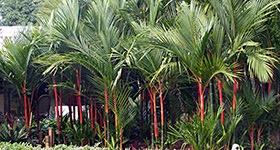
are my queen palms dead?
#1
Posted 05 June 2010 - 06:33 AM
#2
Posted 05 June 2010 - 07:01 AM
"The great workman of nature is time."
"Genius is nothing but a great aptitude for patience."
-George-Louis Leclerc de Buffon-
#3
Posted 05 June 2010 - 07:07 AM
I don't know if your queen palms are alive...but why not try a Butiagrus? It's a hybird between a Queen(Syagrus romanzoffiana) and a Pino/Jelly palm(Butia capitata). It's very tropical looking and should be hardy to the mid-teens.I live in South Louisiana and we were hit really hard this winter by continuous long lasting freezes. I have 16 queen palms in my backyard around my swimming pool and pond area that have not started sending out green shoots yet. A local nursery suggested topping them off so we did that 4 or 5 days ago down to where you could see a little white center( not green). On some, we had to go down about 2 feet to find this. We also fertilized with a liquid palm fertilizer. 4 of these trees are about 20 ft tall, with trunks 1 1/2 ft across. Most of the rest are 2-4 yr old trees. I already replaced 4 of the really small ones I know were dead. Is it time to give up and start replacing the big guys? There's been no change at all since we topped them. I've been looking around our area at other palms that survived the damage but still don't know what kinds to plant. I love the long fronds, but can't do thorns. thanks for any ideas.
Mod Edit: Photos removed due to copyright infringement
Best wishes,
Jonathan
Katy, TX (Zone 9a)
#4
Posted 05 June 2010 - 07:56 AM
#6
Posted 05 June 2010 - 08:34 AM
New Braunfels/San Antonio, TX
Zone 9a-ish
Lows last 9 winters (F): 25, 27, 24, 23, 24, 26, 28, 16, 19 so far this year (10/11).
#7
Posted 05 June 2010 - 02:53 PM
#8
Posted 05 June 2010 - 04:30 PM
The more "queen palm" it looks, the faster it grows, more pindo looking ones grow slower.thanks. It just doesn't look very promising right now. Most all of them have some sort of mushroom/fungus looking stuff growing out of their sides which I've never seen before this year. The mules look real nice. I replaced one smaller queen with a pindo so far, but it will take it years to get any height, unlike the queens. How fast do the mules grow?
Jonathan
Katy, TX (Zone 9a)
#9
Posted 05 June 2010 - 04:51 PM
thanks. It just doesn't look very promising right now. Most all of them have some sort of mushroom/fungus looking stuff growing out of their sides which I've never seen before this year. The mules look real nice. I replaced one smaller queen with a pindo so far, but it will take it years to get any height, unlike the queens. How fast do the mules grow?
Moderately fast. Faster than a Butia, slower than a queen. Remember they are hybrids between the two, so in theory it should be 50% of each one.
New Braunfels/San Antonio, TX
Zone 9a-ish
Lows last 9 winters (F): 25, 27, 24, 23, 24, 26, 28, 16, 19 so far this year (10/11).
#10
Posted 05 June 2010 - 04:56 PM
You probably want to remove the ones with a growth and "throw away" asap. That is a fungus and if left long enough I believe will infest the soil too.
Best to dig up and start anew. I know someone on this board has/sells/raises a lot of mules. You should be able to find via a search..
Better luck to you.
Bill
"The great workman of nature is time."
"Genius is nothing but a great aptitude for patience."
-George-Louis Leclerc de Buffon-
#11
Posted 06 June 2010 - 08:19 AM
#12
Posted 08 June 2010 - 12:30 AM
Ryan
www.collectorpalms.com
Edited by Collectorpalms, 08 June 2010 - 12:33 AM.
#13
Posted 09 June 2010 - 05:36 PM
New Braunfels/San Antonio, TX
Zone 9a-ish
Lows last 9 winters (F): 25, 27, 24, 23, 24, 26, 28, 16, 19 so far this year (10/11).
#14
Posted 10 June 2010 - 04:28 PM
#15
Posted 10 June 2010 - 07:47 PM
Edited by syersj, 10 June 2010 - 07:50 PM.
New Braunfels/San Antonio, TX
Zone 9a-ish
Lows last 9 winters (F): 25, 27, 24, 23, 24, 26, 28, 16, 19 so far this year (10/11).
#16
Posted 11 June 2010 - 03:17 PM
Hardiness Zone 9a, Heat Zone 8, Sunset Zone 28
Averages = rainfall 61". Low/H Averages i=January 60/40, July 90/72
#17
Posted 12 June 2010 - 08:57 PM
Ryan
www.collectorpalms.com
Edited by Collectorpalms, 12 June 2010 - 09:05 PM.
#18
Posted 13 June 2010 - 06:27 PM
My area is southern Waller county, almost into Ft. Bend county. Weather zone 8b to 9a. My queens are about 15 years old, this is the coldest winter since being planted. We experienced 4 nights in sequence of below freezing temps. First night, 24f second night 17f and the last two in the 20'sf. Mine are showing new green fronds, just visable in the last week to 10 days. I have three this age and all are alive. I will post some photos tommorow, as not all of the dead fronds have been removed.
What has amazed me though, is that I had a very small queen planted, ( 2 years ) which I just knew did not survive. Looked at it after the weather started to warm and it looked completely gone. Wrong, after it warmed up a little more, I walked by and just could not believe it, a green frond coming out. Will take a photo of it also. This palm had very little protection other than a little canopy protection from a nearby live oak tree
From what you have stated though, it sounds as if bud rot has entered your palms from the freeze killing the plant tissue in the bud area and moisture having collected in that area with no fungicide being applied.
I wish you the best of luck with your palms.
Marvin
#19
Posted 15 June 2010 - 05:14 PM
I have a degree in meteorology. Did everyone forget about the 80s freezes, and the previous hard winters? January 2010 was a cakewalk, and not a true 20 year freeze, it was just a return to a zone defining winter, and unusual in duration of cool weather. The true 20 year freeze is overdue now, and these weather events come in cycles. Just an FYI. I now thank my blessings that I lost a few palms this time to make room for more hardy stuff, and not waiste any more money on marginal stuff.
Ryan
www.collectorpalms.com
I don't have a degree in meteorology, but I do study weather trends. You're right, this was a cakewalk compared to the 80s freezes, but it was a colder than normal winter. It was colder than a normal zone defining winter. For example, the average winter low in San Antonio over the past 50-100 years is around 21F (low 20s). SA got down to 16F, a full half zone colder than the average long term winter low. It got down to 9F in one of the 80s freezes. A true 20 year freeze would be somewhere between the 2, in the low teens, in my opinion. But this was definitely close to it.
New Braunfels/San Antonio, TX
Zone 9a-ish
Lows last 9 winters (F): 25, 27, 24, 23, 24, 26, 28, 16, 19 so far this year (10/11).
#20
Posted 17 June 2010 - 12:43 PM
I had 4 Queens die and 9 survive this past winter.....tug on the spear, if it pulls...cut down to where there is no more hole and apply fungicide, wait a couple of weeks....if no growth....then dig it up and try another or something else.
Northwest Florida Coastal Hwy. 30A
Min. Temp. 22 degrees F. or -5.55 degrees C. (very rarely)
Normal Temps. 28 to 90 F. or -2.22 to 32.22 C.
Zone 9a, 200 steps to the Gulf of Mexico
#21
Posted 17 June 2010 - 08:02 PM
Z10b
Dry summer subtropical/Mediterranean
warm summer/mild winter
#22
Posted 06 August 2010 - 07:54 AM
I'm in Wharton County, TX, right on the border with Ft. Bend, a little bit warmer than Waller County, but it got down to 19.9 here on the coldest morning. I have a group of three very tall queens way out in the open, near a street, the biggest one came out fine, the other two are slowly greening but their trunks looked sort of shriveled and have mysterious white stuff coming out of some cracks, not very good looking I'd say.
Near the house I have three very old queens, they came out very well, but their dead fronds are still hanging on since they are so far above the reach of any ladder, pole or any other device I can come up with.
I also have three other queens that weren't real big (trunks about 18 feet) that grew very very fast, two never came out and need to be removed and the other put out a little scraggly green which is now turning brown. Not good. It's really sad because those palms were saved when I had a huge oak taken out that towered over them, the crew was very careful and never harmed a frond, this year in the sun they would have been beautiful. But instead, time to start over...
By the way, I posted pics last year of a clump of two triangle palms I had set out in the ground because they had gotten too big, one survived, the other did not, I had covered one much better than the other I guess.
Any tips for removing queens? I took out one a few years ago, and used up two chain saw chains doing it. That will be expensive if I have to remove three palms.
#23
Posted 16 August 2010 - 12:19 AM
I have a degree in meteorology. Did everyone forget about the 80s freezes, and the previous hard winters? January 2010 was a cakewalk, and not a true 20 year freeze, it was just a return to a zone defining winter, and unusual in duration of cool weather. The true 20 year freeze is overdue now, and these weather events come in cycles. Just an FYI. I now thank my blessings that I lost a few palms this time to make room for more hardy stuff, and not waiste any more money on marginal stuff.
Ryan
www.collectorpalms.com
My young Queen palms suffered minimally from this past winters cold weather in the East Brandon (Tampa) area. The Washingtonia robusta's survived, but I feared they might not. Because a slightly colder and longer freeze would have killed the Washingtonia's, I've gotten a few young Trachycarpus fortunei's to inter-plant with the Washingtonia's. Trachy's easily survive the much colder & longer freezes in the Pacific Northwest (Portland) and ought do easily survive any winter weather here in west-central Florida. (I grew several Trachy's in my yard in Portland which survived ice & snow storms as well as the severe annual freezes & continue to thrive after several years in the ground.)
0 user(s) are reading this topic
0 members, 0 guests, 0 anonymous users